RESOURCES
What is a flex office: advantages and disadvantages

WeWork Staff
August 28, 2024
Summarize this article with AI
Discover the concept of a flex office, its advantages, and its disadvantages. Learn how flexible workspaces like WeWork can help your business thrive in today's dynamic work environment.
TL;DR
- A flex office is a ready-to-use workspace with flexible terms, bundling internet, maintenance, and shared amenities into a single fee.
- Setups range from hot desks and dedicated desks to private cabins, meeting rooms, and virtual offices, each suiting a different working pattern.
- The main gains are lower upfront cost, capacity that scales with headcount, and access to premium business districts without managing facilities.
- The trade-offs are limited customisation, shared-space noise, reduced privacy, and add-on charges for meeting rooms, storage, and printing beyond included credits.
- Flex offices suit businesses whose space needs are hard to predict, which is why operators took 26.6% of India's office leasing in Q4 2025.
Introduction
A few years ago, most businesses had only two choices when it came to office space: sign a long-term lease or work remotely. Today, there is a third option that sits somewhere in the middle.
Flexible offices have moved from a niche alternative to a mainstream workplace strategy. India's flex workspace market has grown rapidly since 2020, and according to JLL, flex spaces now account for around 14-15% of total office leasing in the country. Colliers India reports that enterprise clients make up more than half of the market by value, which tells us something important: businesses are not choosing flexible offices because they are a temporary workaround, but because the model solves real operational problems.
That doesn't mean a flex office is automatically the right fit for every company. What you are really evaluating is a trade-off: you get a professional, fully managed workspace without the cost and commitment of a traditional lease, but in return, you give up some degree of control, customisation, and privacy.
Whether that trade-off makes sense depends on how your team works, how quickly you're growing, and what you need from an office. This guide explains what a flex office is, the different types of flex office setups available, the advantages and drawbacks of each, and how to decide whether a flexible workspace is the right choice for your business.
What is a flex office?
A flex office is a ready-to-use workspace that businesses can access without taking on the responsibilities of managing a traditional office. Instead of sourcing furniture, setting up the internet, handling maintenance, or managing facilities, companies move into a flex workspace that is already operational.
Most flex office providers offer a mix of workspace options, including hot desks, dedicated desks, private offices, meeting rooms, and collaborative areas, with amenities such as reception services, high-speed internet, utilities, cleaning, and security typically included as part of the package.
The defining feature is adaptability. Businesses can increase or reduce space requirements as team size, project needs, or working patterns change, making flex offices a practical option for organisations that value agility over permanent office infrastructure.
Types of flex office setups
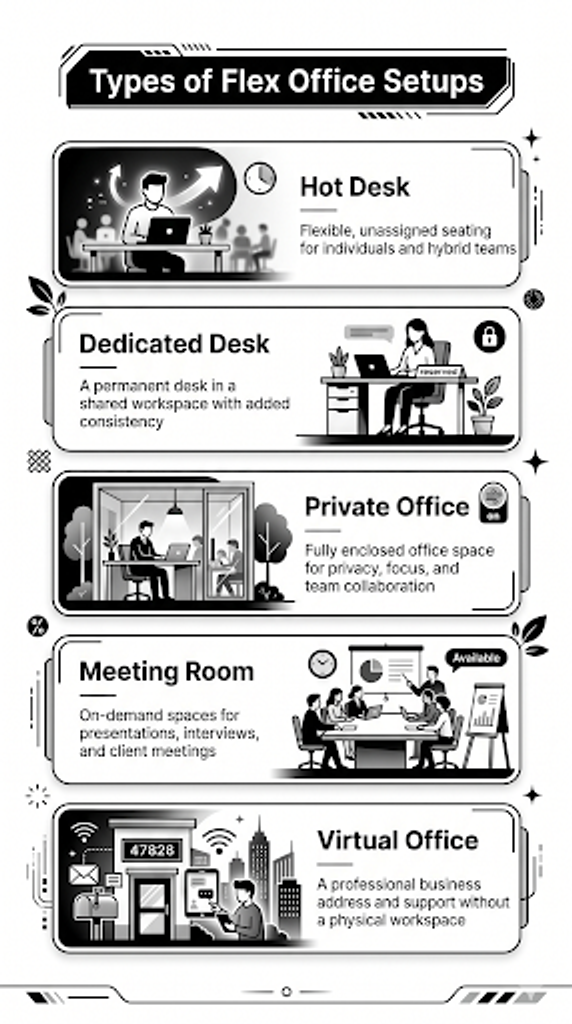
Hot desks
In a hot desk arrangement, members use any available workstation within a shared workspace. Seating changes from day to day, making the format well suited to freelancers, consultants, and remote employees who visit the office occasionally, with access to office infrastructure and shared amenities coming without assigning a permanent desk to each user.

Dedicated desks
Unlike hot desks, dedicated desks reserve a specific workstation for a single user. Personal equipment, documents, and work materials can remain at the desk between visits, creating greater consistency in the workday, which is why professionals who spend several days each week in the office often prefer this format.
Private cabins
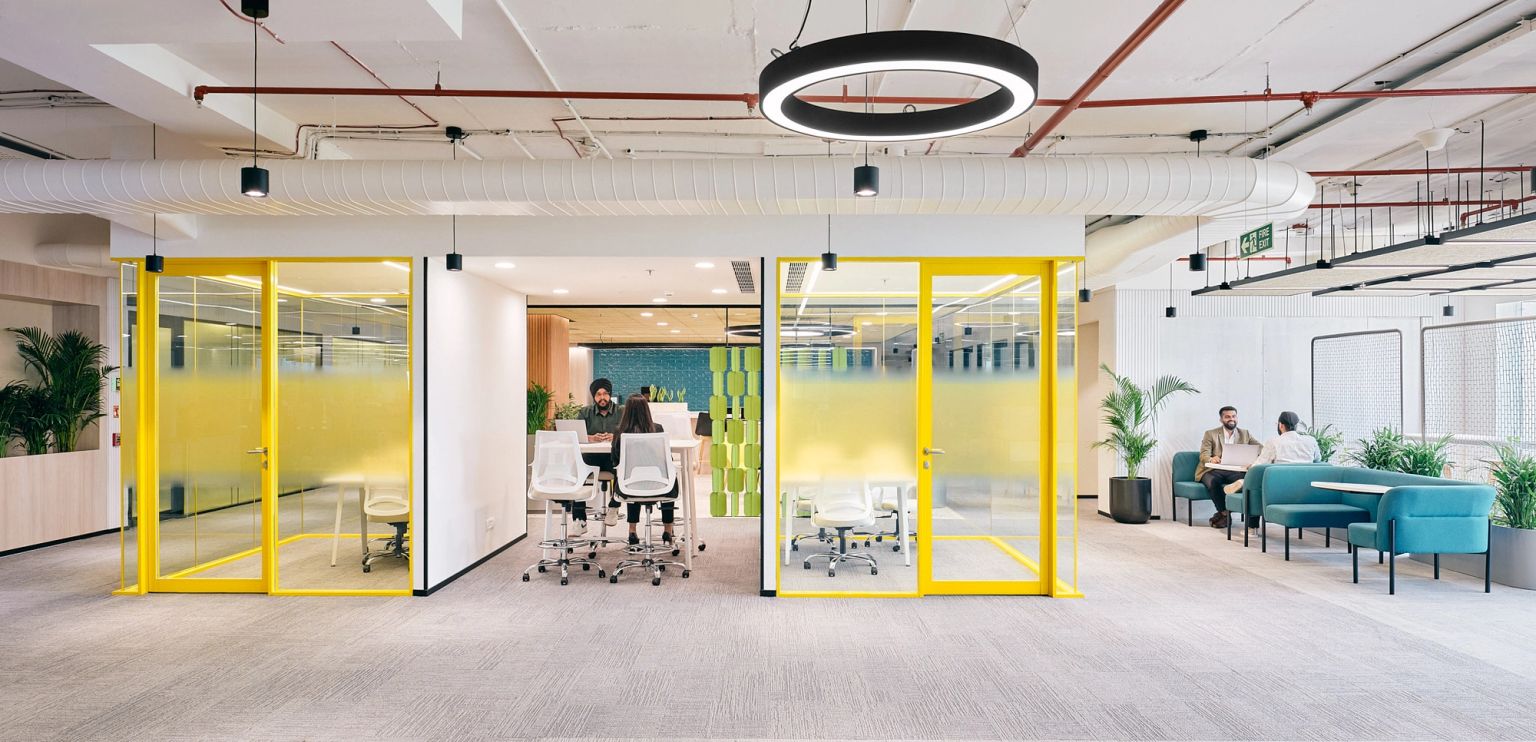
For teams that need a dedicated area, private cabins offer enclosed office space within a flexible workspace. Separate work areas support focused work, internal collaboration, and confidential conversations, and companies gain greater privacy while continuing to use shared facilities such as reception services, meeting rooms, and common areas.
Meeting rooms
Beyond day-to-day workspaces, flex office providers also offer meeting rooms for discussions, presentations, workshops, interviews, and client interactions. Different room sizes accommodate different use cases, with reservations available on demand, so professional meeting facilities become available when needed rather than occupying permanent office space.
Virtual offices
Some businesses need a professional address more than a physical workspace. Virtual offices support that requirement through services such as mail handling, call management, and business registration support, helping companies establish a business presence in a location while operating from elsewhere.
Also read: Hot desks vs dedicated desks
Benefits of a flex office
The appeal of flex offices extends beyond shorter lease terms. For many businesses, the model changes how office space is managed, funded, and used, and from reducing operational overhead to providing access to better facilities, flexible workspaces address several challenges associated with running a traditional office.
Save money
A traditional office comes with expenses that go far beyond rent. Before employees can start working, businesses often need to invest in furniture, internet connectivity, utilities, security arrangements, and office fit-outs, and a significant portion of these costs must be incurred before the office becomes operational.
Flex offices follow a different model. Workspace, internet, maintenance, and shared facilities are bundled into a single fee, reducing the upfront investment required. For example, WeWork India offers workspace access through day passes and monthly memberships, allowing businesses to align workspace spending with current needs rather than committing to a long-term lease.
Easy to scale up or down
Business growth rarely follows a predictable path. Hiring plans change, new projects begin, and team structures evolve over time, so an office that feels spacious today can feel restrictive a year later.
Flexible workspaces are designed to accommodate those changes. A startup with five employees might begin with a handful of hot desks, move to dedicated desks as the team grows, and later shift into a private office for twenty people, with workspace capacity expanding or contracting alongside the business without requiring a complete office relocation.
Access premium locations
Office location influences more than a company's address. It affects employee commutes, client accessibility, and proximity to business opportunities.
Flexible workspace providers often operate from established commercial districts where securing conventional office space can involve significant cost and administrative effort. WeWork India, for example, has locations across business hubs such as BKC in Mumbai, Whitefield in Bengaluru, Hitech City in Hyderabad, Cyber City in Gurgaon, and Viman Nagar in Pune, giving businesses access to professionally managed office space in these areas without handling office setup and facility management on their own.
Build professional connections
A flexible workspace brings professionals from different industries into the same environment. Founders, consultants, remote employees, and growing companies often share common areas, meeting spaces, and workplace facilities, and those shared environments create opportunities for conversations, introductions, and professional relationships to develop organically. Providers frequently support these interactions through networking events, workshops, and member programmes, giving businesses additional ways to connect with the broader professional community.
Use workplace amenities without managing them
Running an office involves a long list of operational requirements: reliable internet, meeting rooms, reception services, cleaning, security, and breakout spaces all contribute to the workplace experience. In a flex office, these services are already integrated into the workspace, so employees can begin working immediately while businesses avoid coordinating multiple vendors and service providers. Access to conference rooms, lounges, wellness facilities, and event spaces further expands the capabilities of the workplace without requiring additional infrastructure investment.
Also read: what is open office
Drawbacks of a flex office
The advantages of flexible workspaces are clear, but the model also comes with trade-offs. The same features that make flex offices adaptable and cost-effective can create limitations in areas such as privacy, workspace control, and day-to-day working conditions. Understanding these drawbacks helps set realistic expectations before choosing a flexible office arrangement.
Limited customisation
A traditional office gives businesses complete control over how the space looks and functions, letting teams design layouts, choose furniture, apply branding, and configure the environment around their specific workflows.
Flex offices operate differently. Workspaces are designed to serve a broad range of occupants, which limits the degree of customisation available to individual companies, and branding opportunities, furniture choices, and layout modifications often depend on the provider's policies and the type of workspace being used.
Noise and distractions
Shared work environments naturally generate more activity than dedicated offices. Conversations, phone calls, meetings, and movement throughout the workspace can create distractions, particularly in open seating areas.
The impact varies depending on the workspace design and the nature of the work being performed, and tasks that require deep concentration may be more challenging in busy coworking environments. To address this, many flex office providers offer private cabins, phone booths, and enclosed meeting rooms that provide quieter spaces when focused work is required.
Variable costs
Flexible workspaces are often associated with predictable pricing, but the total cost can depend on the services a business uses over time. Membership fees may cover core workspace access, while certain services carry additional charges: meeting room bookings beyond included credits, printing services, dedicated storage, locker rentals, and premium amenities can increase monthly expenses. Reviewing what is included in the base plan helps businesses avoid unexpected costs later.
Reduced privacy
Privacy can become a consideration when multiple companies operate within the same workspace. Shared common areas, open seating arrangements, and collaborative environments naturally increase exposure to other occupants.
For businesses that handle confidential discussions, sensitive client information, or regulated data, additional privacy measures may be necessary. Private offices within flex workspaces address many of these concerns by providing enclosed areas for meetings, conversations, and day-to-day operations while retaining access to shared facilities.
Who should use a flex office?
After looking at the benefits and drawbacks, the next obvious question is which businesses actually get the most value from a flex office.
The answer has less to do with company size and more to do with how a business operates. Some organisations need workspace requirements locked in years ahead. Others face changing headcount, evolving work patterns, new market opportunities, or temporary projects, and flex offices tend to be most useful in the latter situations.
| Business situation | Why a flex office fits |
|---|---|
| Startups and early-stage companies | Hiring plans often change quickly during the first few years of growth. A flex office provides professional workspace without requiring a major real-estate commitment from day one. |
| Hybrid and remote-first teams | Office space can be used for onboarding, planning sessions, workshops, client meetings, and team gatherings instead of remaining occupied every day. |
| Businesses entering a new city | A professional address, meeting facilities, and workspace become available immediately while local demand, hiring plans, and market opportunities are evaluated. |
| Project-based teams | Client engagements, implementation projects, and temporary initiatives can require workspace for a defined period. Flex offices align well with these time-bound requirements. |
| Enterprise organisations | Employees across different cities can access a consistent workplace experience through a single workspace provider, simplifying office management across locations. |
Viewed together, these examples reveal a common theme: flex offices work best when future workspace requirements are difficult to predict with complete confidence. That uncertainty may stem from growth, expansion into new markets, distributed teams, or project-based work. As flexible workspace operators accounted for 26.6% of office leasing activity in India during Q4 2025, the model has become an established part of how businesses approach workplace strategy rather than a niche alternative to traditional offices.
Suggested read: Understanding the different types of office spaces
How to choose the right flex office
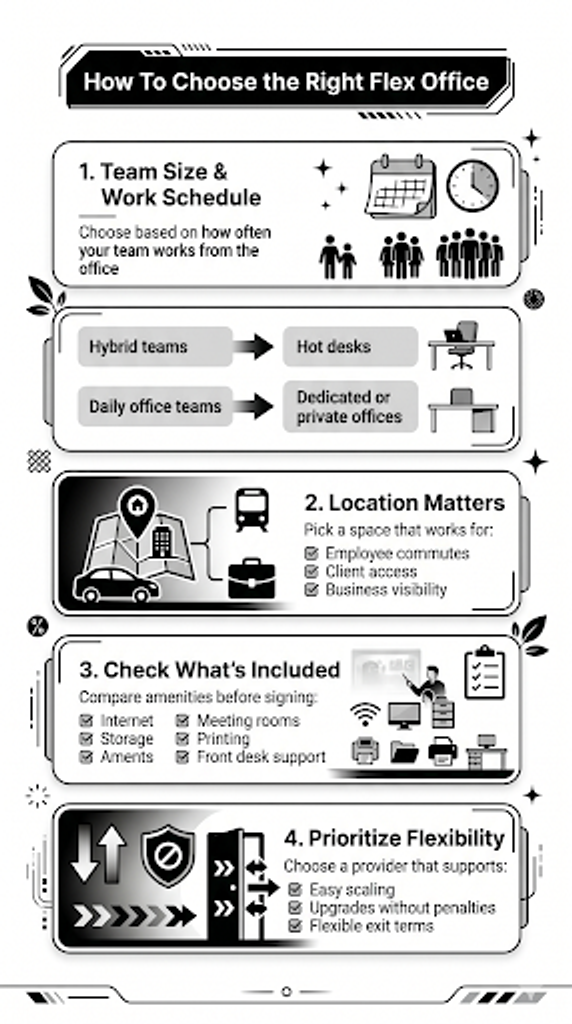
Four questions will help you narrow down your options quickly.
How many people need to be in the office, and on what schedule? A team that works in the office two days a week has different space requirements than a team that is in the office five days a week. The answer determines whether hot desks, dedicated desks, or a private office is the right starting point.
Where does your office need to be? Location affects commute times for your team, proximity to clients, and the professional impression your address creates. Identify the city and preferred business district before you compare options.
What is actually included in the monthly fee? Internet, housekeeping, and front desk access are standard in most flex setups, while meeting room access, storage, and printing credits vary. Read the pricing structure carefully before committing.
How much flexibility do you actually need? If you are growing fast, look for a provider that lets you upgrade your plan without penalty. If you are likely to downsize or move cities, check the exit terms carefully before signing.
Explore flex office spaces with WeWork India
If you're considering a flex office, spending time in an actual workspace is often more useful than comparing plans on a website. A visit can help you assess factors such as commute convenience, workspace layout, amenities, and the overall working environment.
WeWork India operates 70+ centres across Bengaluru, Hyderabad, Mumbai, Pune, Chennai, Delhi, Gurgaon, and Noida. Prospective users can explore different workspace formats, including on-demand desks, coworking spaces, private offices, and meeting rooms, to understand how each setup fits their requirements.
For businesses still evaluating their options, day passes provide access to a workspace for a single day, letting teams experience the office, test facilities, and observe how the space supports collaboration and focused work. Organisations with employees spread across different locations can also explore WeWork All Access, a monthly coworking membership which provides access to WeWork centres across eight cities in India.
Larger companies often have a different set of requirements, particularly when managing teams across multiple locations. WeWork India's enterprise solutions are designed for these scenarios and include options such as dedicated office areas, custom branding, dedicated floors, and multi-city workspace arrangements.
When a flex office makes sense
Organisations with stable workspace needs often know exactly how much space they require and how they want that space configured. Other businesses operate in a more dynamic environment: headcount shifts, new markets emerge, projects begin and end, and office attendance patterns evolve. In these situations, access to workspace becomes more important than ownership of it, which is why flexible workspaces now serve everyone from startups and remote teams to established enterprises. The model has expanded well beyond coworking and become a mainstream way of accessing professional office infrastructure.
The right workspace, in the end, is the one that fits where your business is right now, whether that means starting with a single hot desk or a multi-city enterprise arrangement.
Explore workspace options at WeWork India
Frequently asked questions
What is a flex office?
A flex office is a workspace with flexible lease terms, multiple seating configurations, and shared amenities such as internet and meeting rooms. It allows businesses to take only the space they need without committing to a long-term lease.
How is a flex office different from a traditional office lease?
A traditional office lease locks your business into a fixed space for a set term, typically three to five years, with full responsibility for fit-out, maintenance, and infrastructure costs. A flex office covers those costs in the monthly fee and lets you adjust the size or location of your space as your needs change.
How much does a flex office cost?
Costs vary by city, setup type, and provider. Hot desks are the most affordable entry point, while private offices for larger teams carry a higher monthly rate. Most plans bundle core amenities, including internet and housekeeping, into the base fee.
What amenities are typically included in a flex office?
Most flex offices include high-speed internet, housekeeping, front desk support, and access to common areas as standard. Many also include meeting room credits, pantry access, and community events. Premium amenities such as additional storage or printing are often charged separately.
Can I use a flex office address for business registration?
This depends on the provider and the plan you choose. Some providers offer virtual office plans that include a professional business address suitable for GST and company registration. Check with your provider about the documentation they can supply before signing up.
Related Blogs:
RESOURCES
In this blog, we will explore innovative ways to utilise meeting rooms effectively, ensuring they become key assets in your business strategy.
RESOURCES
In the last few years, the world has evolved a lot, and so have we. Especially since the pandemic, video conferencing has made our lives easier. However, in-person team meetings and collaborations continue to remain significant.
RESOURCES
The benefits of coworking spaces have drastically one upped traditional offices. From startups, to entrepreneurs, to large corporations, they cater to everyone. Its benefits help......