WORKSPACE SOLUTIONS
What is a virtual office? Complete guide for businesses

WeWork Staff
August 27, 2026

Summarize this article with AI
A virtual office gives your business a premium address, mail handling, and GST registration support without a physical lease. Explore WeWork India's plans.
TL;DR
Key takeaways
- According to Colliers India Q1 2025, Grade A office rents rose 8% year-on-year in India's top cities, with prime metro markets now averaging over ₹100 per square foot monthly, making virtual offices a far more cost-effective choice.
- A virtual office allows you to register your company, obtain GST numbers in multiple states, open business bank accounts, and project professional credibility without a physical lease.
- India's regulatory framework fully supports virtual offices for company incorporation and GST registration, provided the arrangement is backed by a valid licence agreement and a No Objection Certificate from the premises owner.
- WeWork India offers virtual office plans from approximately ₹1,099 per month across more than 73 locations in eight cities, featuring all-inclusive pricing, no lock-in periods, and cost reductions of 25-30%.
India is home to nearly 2 lakh DPIIT-recognised startups, according to the Department for Promotion of Industry and Internal Trade, and many of these businesses need a professional address for company registration, GST compliance, banking requirements, and client-facing credibility, without being able to justify the cost of a traditional office lease. A virtual office solves exactly this problem.
It gives you a premium business address, mail handling, GST registration support, and access to meeting rooms on demand, without requiring you to commit to a physical workspace. It's built for founders, remote teams, small businesses, and growing companies that want to project a professional presence across Indian cities without heavy upfront costs.
This guide explains what a virtual office is, how it works, what a typical plan includes, and who benefits the most. You will also find India-specific compliance details, a comparison with physical offices, key benefits, and a step-by-step overview of setting up a virtual office with WeWork India.
What is a virtual office?
A virtual office is a service that provides your business with a professional address, mail handling, phone services, and access to physical workspace amenities on demand, without requiring a long-term office lease. It allows you to register your company, receive correspondence, open business bank accounts, and project credibility while working from any location you choose.
For businesses in India, virtual offices serve a critical compliance function, since they provide a valid registered address for company incorporation with the Ministry of Corporate Affairs and for obtaining a GST registration number under India's Goods and Services Tax framework. That means you can establish your business legally and begin operations without signing a multi-year commercial lease.
How does a virtual office work?
Setting up and running a virtual office is a straightforward process, and once you understand the mechanics, it's easy to see why this model appeals to businesses of every size. Here is how it typically works, step by step.
- You begin by choosing your location and plan, selecting a business address from your provider's available locations. With WeWork India, for example, you can pick from premium addresses in Mumbai, Bengaluru, NCR, Hyderabad, and Pune, among other key cities across India, with plans ranging from a basic business address to more comprehensive packages that include mail handling, call forwarding, GST registration support, and meeting room credits.
- Next, you submit your documentation: the required KYC documents, which typically include identity proof, address proof, a PAN card, and your business registration details. Many providers now support fully digital onboarding, and WeWork India, for instance, allows you to complete the process in under 15 minutes.
- Once your documents are verified and your agreement is signed, your address activates. You can begin using it immediately on official correspondence, invoices, company registration filings, and marketing materials, and all mail and packages sent to that address are received and managed by the on-site team at your chosen location.
- From there, you can access workspace amenities on demand. Most virtual office plans include credits or booking options for meeting rooms and day-use desks, so when you need to host a client meeting, conduct an interview, collaborate with your team, or work from a professional environment for a day, you simply book the space at your provider's location.
Virtual office plans start from around ₹1,099 per month with providers such as WeWork India, giving you a premium address at a fraction of the cost of physical space. If you are in the early stages of planning your setup, WeWork India's guide to virtual addresses for business covers the documentation, process, and compliance aspects in more detail.
What's included in a virtual office plan?
Virtual office plans vary by provider and service tier, but most share a core set of features designed to give your business a professional and legally compliant foundation. Understanding what is included helps you select the right plan for your needs. Here are the components typically offered:
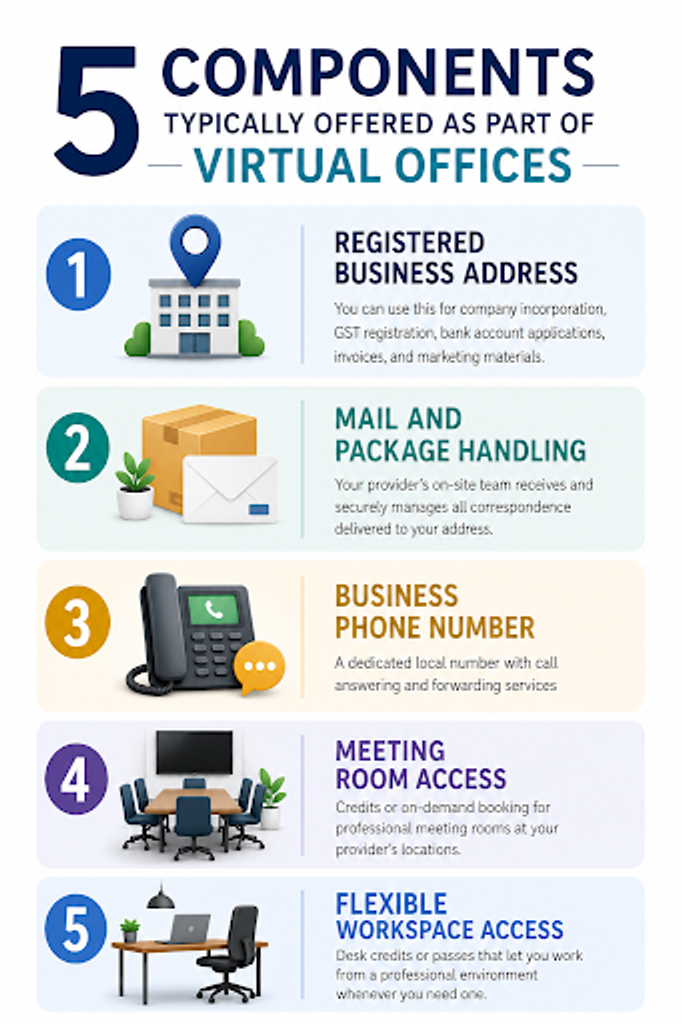
Some plans also include value-added services such as GST registration assistance, document attestation, compliance support, and dedicated account management. WeWork India's virtual office plans bundle a premium address with registration support and access to meeting rooms across multiple Indian cities, making it straightforward to establish your business in a new market.
According to Zinnov-NASSCOM's India Tech Start-Up Report 2025, India's technology startup ecosystem now has 31,000-34,000 active startups, and virtual office addresses have become a popular choice among these startups for business registration, letting them satisfy compliance requirements in multiple states without maintaining a physical presence in each one.
Key benefits of a virtual office
A virtual office is more than a mailing address. It delivers measurable advantages across your operating costs, professional image, regulatory compliance, and operational flexibility, whether you are launching a startup, scaling to new cities, managing a distributed team, or entering a new market.
Cost savings. Setting up a traditional office in a metro city involves more than monthly rent: security deposits (often six to twelve months' rent upfront), interior fit-out expenses, utility connections, maintenance charges, and ongoing administrative costs, against a backdrop where Grade A office rents across India's top cities have already risen 8% year-on-year (per the Colliers India Q1 2025 data cited above). A virtual office eliminates nearly all of these line items, replacing them with a predictable monthly fee and no upfront deposits, fit-out requirements, utility overheads, or long-term lease lock-ins.
Professional business address. Your business address plays a direct role in how clients, investors, partners, and financial institutions perceive your company. A registered address in a recognised commercial hub, such as Bandra Kurla Complex in Mumbai or Cyber City in Gurugram, signals stability and professionalism to anyone who looks up your business details, which matters especially when you apply for a business bank account, since most Indian banks require a valid registered office address as part of their KYC verification and a premium commercial address simplifies this process.
Business registration and GST compliance. You can use a virtual office address to incorporate your company with the Registrar of Companies and to register for GST under the Goods and Services Tax framework. For GST registration specifically, a virtual office address can serve as your principal place of business or an Additional Place of Business (APOB), depending on the structure of your filing. For a closer look at using a virtual office as your company's registered office, WeWork India's resource on virtual offices for GST registration covers the specific documentation requirements in detail.
Who should use a virtual office?
If your work does not require a permanent physical space but your business still needs a credible registered address and compliance infrastructure, this model is a strong fit. The profiles that benefit most include:
- Solo entrepreneurs and consultants who operate from home or client sites but need a registered address for invoicing, contracts, government filings, and banking requirements.
- Early-stage startups looking to direct capital toward product development, hiring, marketing, and customer acquisition rather than rent and security deposits.
- Remote-first and distributed teams that work across cities but need a centralised business address, mail management, compliance documentation, and periodic access to meeting rooms for in-person collaboration.
- Businesses entering new cities that want to establish a legal and professional presence before committing to a long-term physical lease.
- International companies setting up in India that need a local registered address to incorporate, open a bank account, build credibility, and launch operations without a full-scale office setup.
According to Knight Frank India's 2026 Flex Space Occupier Intelligence report, India's flexible workspace market reached 18.6 million square feet of annual transaction volume in 2025, up from just 2.2 million in 2017. If your business is growing but your workspace needs remain variable, a virtual office provides the credibility and structure you need without long-term commitments.
Virtual office vs physical office
Choosing between a virtual office and a physical office depends on your business model, team structure, budget, and growth plans. The table below highlights the key differences across the factors that matter most to businesses in India.
| Feature | Virtual office | Physical office |
|---|---|---|
| Monthly cost | Approximately ₹1,099 to ₹5,000 | ₹30,000 and above, depending on city and size |
| Upfront investment | Minimal, no security deposit or fit-out | Security deposit, interior fit-out, furnishing |
| Location flexibility | Multiple cities via separate plans | Fixed to a single address |
| Commute | None required | Daily commute to office |
| Team collaboration | On-demand meeting room bookings | Daily in-person access |
| Compliance (GST and registration) | Supported with valid documentation | Supported with lease agreement |
| Scalability | Add new city addresses as needed | Requires a new lease per location |
A physical office is the right choice if your team collaborates in person daily and your operations require dedicated on-site infrastructure, while a virtual office works better when your priorities are regulatory compliance, professional credibility, geographic flexibility, and cost control without a long-term lease. Many Indian businesses combine both models, maintaining a virtual office in cities where they need a registered presence and using physical space only where daily operations demand it.
According to JLL India's Q3 2025 research, office rental values rose year-on-year across all major Indian cities, with Hyderabad up 18.7%, Bengaluru up 8%, and Delhi NCR up 7.6%, making cost-effective alternatives like virtual offices increasingly attractive for growing businesses.
Virtual offices in India
The market for virtual offices in India has expanded rapidly in recent years. JLL India reports that gross office leasing across the country's top markets hit a record 83.3 million square feet in 2025, with flexible workspace accounting for 26.6% of Q4 2025 leasing activity, and the number of virtual office providers in major metros has grown alongside it, giving businesses more choice in location quality, pricing, service scope, and compliance support.
When selecting a virtual office provider in India, confirm that the address is situated in a commercial property with valid occupancy certificates, and that it's recognised by the local Registrar of Companies and the relevant state GST authority. Verify that the provider offers digital KYC, a clear licence agreement, dedicated account management, and assistance with compliance documentation, since these factors determine how quickly your address can be activated for official use.
Explore WeWork India's virtual office locations across India.
How to set up a virtual office with WeWork India
Getting started with a virtual office through WeWork India is a streamlined process, and the entire setup can be completed online.
Select your city and plan, choosing from premium locations across Mumbai, Bengaluru, Delhi NCR, Hyderabad, Pune, Chennai, and other major Indian cities. Plans range from a standalone business address for company registration to comprehensive packages that include GST registration support, meeting room credits, compliance documentation, and dedicated account management.
Complete your KYC online. The onboarding process is fully digital: upload your identity proof, address proof, business PAN, and incorporation documents through a secure portal, and WeWork India's team reviews your submission and typically completes verification within a few business days.
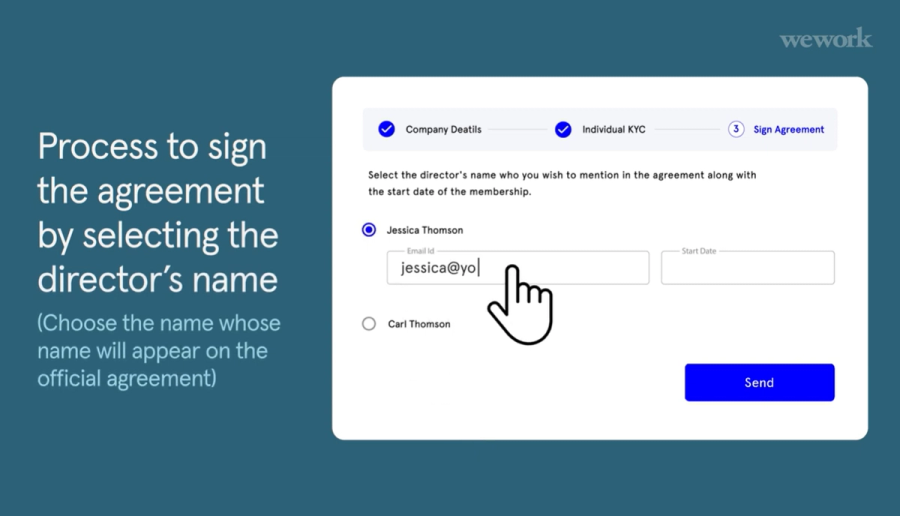
Once your KYC is approved, you sign your licence agreement. You receive a digital licence agreement outlining your plan terms, address details, service inclusions, and renewal conditions, and signing is completed electronically, so there is no need to visit a location in person.
After signing, your registered address goes live and you can use it immediately on regulatory filings, bank account applications, invoices, client-facing materials, and official correspondence. Your plan also includes on-demand access to meeting rooms and professional flexible workspace across WeWork India's network.
The process from sign-up to active address typically takes less than a week. If your business requires a registered presence in multiple cities simultaneously, you can set up additional virtual office addresses in parallel. If you are an early-stage startup weighing this decision, WeWork India's guide to virtual offices for startups addresses the specific considerations founders face.
Making the right call for your business
Whether you are registering a new company, expanding into a second city, or managing a distributed team, a virtual office gives you the compliance infrastructure and professional credibility your business needs without a long-term lease. That cost advantage over a physical office only grows in India's metro cities, where commercial rents continue to climb, and it adapts as you do, letting you add addresses in new states without proportional increases in overhead.
With plans starting from approximately ₹1,099 per month across 70+ centres in eight major cities, all-inclusive pricing, no lock-in commitments, and potential cost reductions of 25-30% compared to traditional office setups, WeWork India's virtual office model, backed by a digital onboarding process that takes less than a week from sign-up to active address, is built for businesses that want to scale efficiently.
As India's startup ecosystem grows and more companies embrace remote and hybrid work models, virtual offices will become an even more essential part of business infrastructure. If you are ready to establish a professional, compliant presence without the cost and complexity of a physical lease, now is a practical time to start.
Frequently asked questions
What is the difference between a virtual office and a virtual address?
A virtual address provides only a registered business address. A virtual office is a broader service that includes mail handling, a business phone number, meeting room access, and compliance support alongside the address.
Can I receive legal notices at my virtual office address?
Yes, legal notices delivered to your registered virtual office address are received by the on-site team and forwarded to you. Ensure your provider offers real-time notifications so you can respond promptly.
Can I use one virtual office address for multiple businesses?
Policies vary by provider and jurisdiction. Some providers allow multiple businesses to register at the same address, while others restrict it. Check with your provider and local regulatory requirements before registering additional entities.
Can I switch my virtual office address to a different city later?
Yes, you can set up a new virtual office in a different city and update your registered address with the Registrar of Companies or GST authority by filing the required amendment forms.
Are virtual offices recognised by investors and venture capital firms?
Most investors evaluate your product, traction, team, and financials rather than your office type. A virtual office from a recognised provider signals cost discipline and operational efficiency, which many investors view positively.
Related Blogs:

WORKSPACE SOLUTIONS
A workspace is not just about the work. It is also about providing employees a space that allows them the freedom to work where, when, and how they want. Flexibility...

WORKSPACE SOLUTIONS
Your office is the one brand touchpoint clients, candidates, and your own team experience every single day — here's how to design it on purpose.

WORKSPACE SOLUTIONS
Businesses should grow smart, not just big. Today, when every business looks forward to expanding its operations or network