NEWS & INSIGHTS
GCC in India: Top states, cities and what’s driving the boom [2026]

WeWork Staff
September 24, 2025

Summarize this article with AI
Discover how Indian states like Karnataka, Telangana, Maharashtra, Tamil Nadu, and Delhi-NCR are vying to attract Global Capability Centres (GCCs). Learn which states are leading the race and how India is set to remain the world’s top GCC destination.
TL;DR
- India is the world's undisputed GCC capital, with states competing aggressively through dedicated policies, tax incentives, and infrastructure investment to attract new centres.
- Karnataka leads the race, but Telangana, Maharashtra, Tamil Nadu, and Delhi-NCR each offer distinct strengths in talent, cost, and sector specialisation.
- Tier-2 cities are emerging as credible, lower-cost alternatives for companies expanding or setting up satellite centres beyond the major hubs.
- Flexible workspace has become the practical first step for GCC teams setting up in India, offering speed of setup and scalability without a long-term lease commitment.
- With 73+ centres across Bengaluru, Hyderabad, Pune, Mumbai, and Delhi-NCR, WeWork India lets GCC teams move in fast, scale without a long lease, and skip the infrastructure build-out entirely.
India leads the world in Global Capability Centres. According to JLL’s India GCC Guide 2026, the country now hosts more than 2,000 centres and employs about 2 million professionals. The pace of growth has not slowed, with dozens of new centres added in 2026.
If you are evaluating India as a location for your global capability centre, the first question is where. Karnataka, Telangana, Maharashtra, Tamil Nadu, and Delhi-NCR are each competing aggressively for new investment, with distinct advantages in talent, cost, policy support, and sector focus. Your choice of state will shape your hiring pipeline, cost structure, and how quickly you move from decision to operational.
This guide breaks down each major state and city using 2026 data, explains what sets a leading GCC hub apart from an emerging one, and gives you a clear picture of how workspace infrastructure fits into the GCC setup decision.
What is a GCC, and why do companies set them up?
A Global Capability Centre, also called a Global In-house Centre or captive centre, is a wholly owned offshore unit set up by a multinational company to deliver strategic functions in-house, rather than through a third-party vendor. GCCs are not an outsourcing arrangement; they are a strategic operating model that places capabilities directly within the company's structure.
The functions handled by GCCs have expanded considerably since the model first emerged in India in the late 1990s. Today's GCCs run product engineering, AI and analytics research, finance and accounting, legal operations, and HR for their parent companies. In sectors like financial services, automotive, and pharmaceuticals, GCC teams in India are making decisions that affect global product roadmaps, not just supporting functions.
For companies with long-term plans for India, the model offers direct control over IP, data security, and talent development; institutional knowledge built inside the company rather than a vendor's workforce; faster alignment between onshore strategy and offshore execution; and a long-term retention advantage as company culture develops in-house. For a detailed look at how to set one up, see our guide to setting up a Global Capability Centre in India.
Why India is the world’s GCC capital
India did not become the world's GCC capital by accident. Five structural advantages have compounded over 25 years of GCC activity, creating an ecosystem no other country has come close to replicating.
- Talent depth: India produces 2.5 million STEM graduates annually, more than any other country, according to NASSCOM, with a deep pool of mid-career professionals adding senior-level capacity that early-stage GCCs can draw from immediately.
- Cost efficiency: Operating a GCC in India costs 30-40% less than an equivalent function in the US or UK.
- English-speaking workforce: India has over 125 million English-speaking professionals, making cross-border collaboration straightforward.
- Time zone advantage: IST overlaps with US morning and European afternoon hours, letting GCC teams work in real time with both markets.
- Ecosystem maturity: 25+ years of GCC activity has built a deep support infrastructure of legal, compliance, HR, and real estate advisory services.
To understand how GCCs connect to broader shifts in global business structures, see our analysis of GCCs and the restructuring of global value chains.
What does a GCC hotspot mean?
A GCC hotspot is a location that has established itself as a preferred destination for multinational companies setting up offshore capability centres. Not every city that hosts a handful of GCCs qualifies; the distinction lies in talent pool quality, modern office infrastructure, speed of regulatory approvals, ecosystem maturity, and quality of life.
In India, a small number of cities account for the overwhelming majority of GCC activity: Bengaluru, Hyderabad, Pune, Mumbai, Chennai, and an expanding cohort of Tier-2 cities beginning to close the gap on the established leaders.
Why are states competing to attract GCCs?
The GCC boom is more than office activity. Each new GCC brings a concentration of high-skilled employment and economic activity well beyond the centre itself. Research from NASSCOM indicates a mid-sized GCC with 500 employees generates indirect employment for two to three times that number in ancillary services, from facilities management to legal, accounting, and recruitment.
State governments are competing for this activity through:
- Dedicated GCC policies with defined targets, such as Karnataka's 2024–2029 policy targeting 500 new centres and USD 50 billion in additional revenue by 2029
- Tax incentives and capital subsidies for companies establishing or expanding GCC operations
- Fast-track approval mechanisms, such as Telangana's TS-iPASS system, cutting approval timelines from months to days
- Investment in IT parks, special economic zones, and smart city infrastructure
- Promotion of R&D partnerships, startup ecosystems, and university talent pipelines
Top Indian states in the GCC race
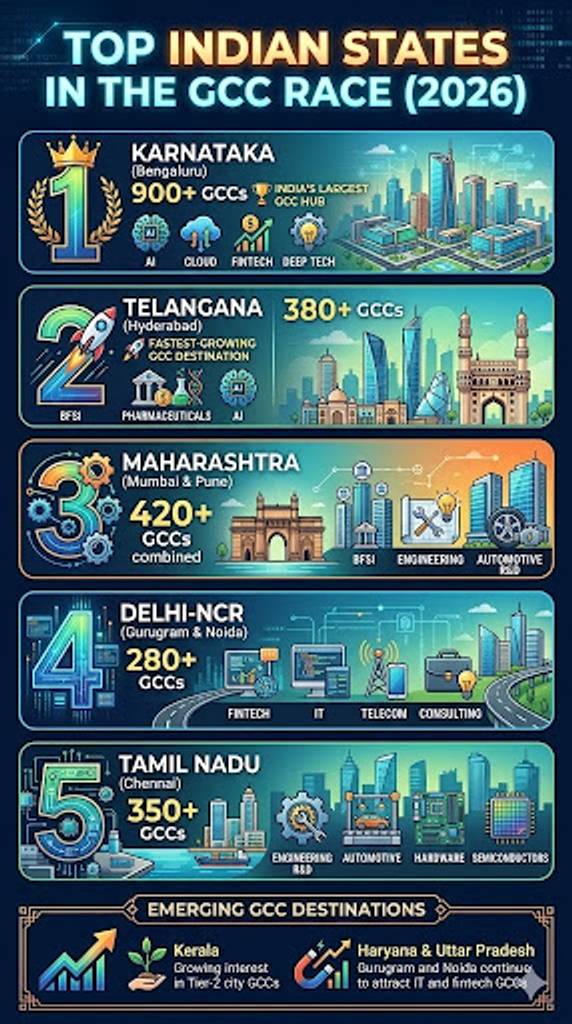
India’s GCC activity is concentrated in five major states, each with a distinct sector focus, policy environment, and geographic profile. Here is how they compare in 2026.
1. Karnataka (Bengaluru)
Karnataka is India's undisputed GCC leader. The state hosts approximately 900 GCCs, accounting for 34-39% of India's total, and launched India's first dedicated GCC policy in 2024, targeting 500 new centres, 350,000 jobs, and USD 50 billion in additional revenue by 2029.
The state's core strengths are AI, cloud computing, fintech, and deep tech, with Goldman Sachs, Intel, and Walmart among its major GCC occupiers. WeWork India operates its largest presence in Bengaluru across the city's key business districts, offering flexible office space for GCC teams at every stage of growth.
2. Telangana (Hyderabad)
Hyderabad is the fastest-growing major GCC city in India. Telangana hosts approximately 380+ GCCs, with a focus on BFSI, pharmaceuticals, and AI, and captured the highest share of new GCC activity in 2025, per NASSCOM.
Notable occupiers include Microsoft's India Development Centre and Vanguard's largest global technology centre. WeWork India's Hyderabad offices span the city's primary IT corridors, including HITEC City and the Financial District.
3. Maharashtra (Mumbai and Pune)
Maharashtra's GCC footprint combines two distinct city profiles. Mumbai leads in BFSI, hosting approximately 207 GCCs concentrated in BKC and Lower Parel. Pune has a stronger engineering and automotive R&D profile, hosting approximately 360+ GCCs, per Zinnov data, up from around 210 in 2019, and is projected to cross 500 centres by 2030. Combined, Maharashtra accounts for over 560 GCCs.
BMW Group IT, Mercedes-Benz Tech, and Eaton are among the notable GCC occupiers in Pune, alongside a strong cohort of financial services GCCs in Mumbai. Explore WeWork India's offices in Pune and Mumbai for enterprise-grade workspace options across both cities.
4. Delhi-NCR
Delhi-NCR is India's fourth-largest GCC hub, with approximately 280+ centres across Gurugram, Noida, and the wider NCR region, strongest in IT, telecom, consulting, and fintech. Flexible workspace adoption among GCC employees is notably high in NCR.
WeWork India's Delhi-NCR offices span the key business districts of Gurugram and Noida, providing GCC teams with professional workspace options across the region.
5. Tamil Nadu (Chennai)
Tamil Nadu hosts approximately 350+ GCCs, with Chennai accounting for roughly 300 of those centres. The state's core strengths are engineering R&D, automotive, and hardware development, and it has recently accelerated its focus on semiconductors and electric vehicles through dedicated state policies, attracting manufacturing-adjacent GCCs.
WeWork India's Chennai offices give GCC teams flexible, ready-to-scale workspace in the city's key business districts, in line with WeWork India's presence across every other state hub in this guide.
6. Other emerging states
Kerala is actively courting GCC investment, with over 30 multinational companies in the queue to establish operations, particularly in Tier-2 cities. Haryana and Uttar Pradesh, specifically Gurugram and Noida, are emerging as IT and fintech hubs for companies seeking a presence in the NCR at competitive costs.
Tier-2 cities: the next wave of GCC growth
The concentration of GCC activity in India's major metros is beginning to shift. Tier-2 cities are emerging as credible alternatives, particularly for companies expanding existing GCC operations or setting up satellite centres alongside a primary hub.
The primary appeal is cost. Operating a GCC in cities like Coimbatore, Kochi, Ahmedabad, Jaipur, Chandigarh, or Nagpur can deliver 30-40% lower operational costs than in Bengaluru or Hyderabad, according to NASSCOM and Zinnov research. Real estate, compensation benchmarks, and support services are all materially cheaper, and attrition rates tend to be lower.
Adoption is accelerating alongside the cost advantage: NASSCOM data points to 30-40% growth in GCC and flexible workspace demand from Tier-2 cities in the years ahead, with Coimbatore, Indore, Jaipur, Nagpur, Bhubaneswar, and Chandigarh emerging as the biggest beneficiaries.
The talent argument has also strengthened. India's investment in NITs, IITs, and state-level engineering colleges has created strong local talent pools. State governments are reinforcing this by extending incentives beyond the major metros: Karnataka has already extended its GCC policy to Mysuru and Mangaluru, and Tamil Nadu's semiconductor policy creates opportunities in Coimbatore and Hosur. Need a scalable GCC workspace in India? WeWork India helps you move in fast, without a long-term lease. Explore workspace options
Flexible workspace for GCCs in India
When a multinational sets up a GCC in India, workspace is among the first physical decisions it faces. Traditional commercial leases, which require 5 to 9-year commitments, work well for established GCCs with stable headcount. For most new GCC setups, that model carries real risk: committing to a large floor plate before you know your actual headcount trajectory.
Flexible workspace has become the practical choice for GCC teams at the setup stage and, increasingly, at the growth stage. Moving into a flexible office means you can start with exactly the desk count you need and scale up or down as your team evolves, without fit-out costs, furniture procurement delays, or facilities management overhead.
WeWork India's GCC workspace solutions are built for enterprise teams that need professional office infrastructure without the commitment overhead of a conventional lease. With 73+ centres across 8 Indian cities, including Bengaluru, Hyderabad, Pune, Mumbai, and Delhi NCR, WeWork India can accommodate GCC teams from day one, covering private offices, dedicated desks, client-facing meeting rooms, and enterprise office solutions in India for large teams requiring custom, scalable setups.
The relevant proof points for GCC leaders evaluating workspace: businesses using flexible workspaces reduce real estate costs by 25 to 30% per employee compared to traditional setups, and for early-stage GCCs, savings can reach 40 to 60% annually, per JLL's GCC India research. WeWork India's all-inclusive pricing covers internet, housekeeping, community events, and amenities.
The future of GCCs in India
India’s GCC sector is not approaching a plateau. JLL’s India GCC Guide 2026 projects that the sector will host 2,500+ centres, employ 2.8-2.9 million professionals, and generate USD 105 billion in annual revenue by 2030. Four identifiable trends are driving that growth.
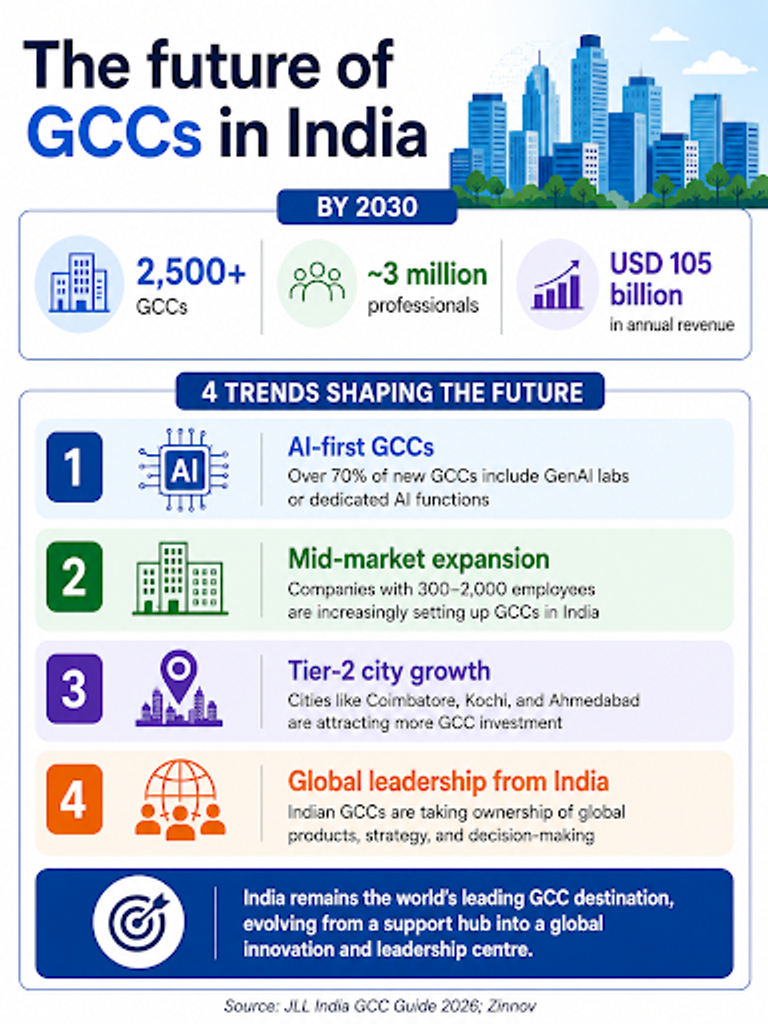
- AI-first GCCs: more than 70% of new GCCs established in 2025 included a GenAI lab or dedicated AI function, per Zinnov.
- Mid-market expansion: organisations with 300 to 2,000 employees are now establishing GCCs in India at a meaningful rate.
- Tier-2 acceleration: new GCC activity in Tier-2 cities is outpacing growth in major hubs, with cities like Coimbatore, Kochi, and Ahmedabad moving from emerging to established.
- Global leadership from India: GCC heads in Bengaluru, Hyderabad, and Pune are increasingly responsible for decisions that affect global product roadmaps.
India’s position as the world’s GCC destination has remained unchanged for 25 years. The question is no longer whether to set up here. It is about doing it efficiently, in the right location, and with the right infrastructure from the start.
The GCC opportunity in India is only growing.
India's position as the world's GCC capital is not a temporary advantage. The talent supply, cost structure, policy environment, and ecosystem maturity that made it the default destination are deepening, not fading. States are accelerating their competition for new centres, and the range of viable locations now extends well beyond a handful of established metros.
As GCCs scale across India's cities, workspace infrastructure becomes a strategic decision rather than just an operational one. Across 70+ centres, WeWork India offers enterprise-grade offices that let teams launch fast, scale efficiently, and operate from India's best business districts, free of a long-term lease.
If you are planning a GCC in India or looking to expand an existing footprint, the workspace infrastructure you need is already in place. Setting up a GCC in India? WeWork India offers flexible, ready-to-scale offices across Bengaluru, Hyderabad, Pune, Mumbai, and Delhi NCR. Explore GCC workspace options.
Frequently asked questions
1. What is a GCC in India, and how does it differ from outsourcing?
A GCC is a wholly owned offshore unit that the parent company operates directly, giving it full control over talent, intellectual property, and strategic functions such as technology, R&D, and analytics; outsourcing hands that control to a third-party vendor, while a GCC keeps it in-house.
2. Which state in India has the most GCCs?
Karnataka leads with approximately 900 GCCs, accounting for 34-39% of India’s national total, with Bengaluru as the primary hub. The state’s 2024–2029 GCC policy targets 500 new centres and USD 50 billion in additional revenue.
3. Why are tier-2 cities gaining attention for GCC setups in India?
Tier-2 cities offer 30-40% lower operational costs than established metros, according to NASSCOM and Zinnov’s 2025 research. Lower attrition, expanding local talent pools, and state policies now extending incentives beyond major hubs make them increasingly competitive.
4. How much is India’s GCC sector expected to grow by 2030?
India’s GCC sector is projected to reach USD 105 billion in revenue by 2030, with 2,500+ centres and 2.8-2.9 million employees, per JLL’s India GCC Guide 2026. That is up from 2,000+ centres and 2 million professionals today.
5. What are the key factors companies consider when choosing a GCC location in India?
Companies evaluate talent availability, operational costs, approval speed, infrastructure quality, and sector ecosystem fit. Karnataka, Telangana, and Maharashtra tend to score strongest across most criteria, but the right location depends on your sector, team size, and growth timeline.
6. How can WeWork India support a company setting up a GCC?
WeWork India offers enterprise-grade flexible offices across 70+ centres in 8 Indian cities, including Bengaluru, Hyderabad, Pune, Mumbai, and Delhi NCR. GCC teams can move in quickly without long-term lease commitments, with all infrastructure included from day one.
Related Blogs:

NEWS & INSIGHTS
The world of finance saw a drastic shift in its functional trajectory the moment it was hit by the wave of AI. Like all the other fields of commerce,

NEWS & INSIGHTS
The concept of flexible workspaces has changed the work landscape.

NEWS & INSIGHTS
In the evolving landscape of workplace design, the open office concept has gained significant popularity. This modern approach aims to foster collaboration, enhance flexibility