NEWS & INSIGHTS
How to set up a global capability centre (GCC) in India: 2026 guide

WeWork Staff
May 18, 2025

Summarize this article with AI
Explore how Global Capability Centres (GCCs) drive business efficiency and innovation. Learn the steps to set up a GCC in India and why it's a preferred global hub.
TL;DR
- Setting up a GCC in India typically spans 12 to 24 weeks across phases: strategy and planning, legal entity formation, infrastructure and workspace, talent acquisition and launch.
- Bengaluru, Hyderabad, Pune, Chennai, Mumbai, and NCR are India's primary GCC hubs, each with distinct industry strengths,
- Tier-2 cities such as Jaipur, Ahmedabad, and Coimbatore offer 15-25% lower operating costs and untapped talent pools.
- Infrastructure is often the biggest bottleneck in GCC setup: traditional office leases take 6 to 12 months and require significant capital.
- Flexible workspace solutions let your team become operational within days and scale without long-term commitments.
- WeWork India operates 70+ centres across 8 Indian cities, giving GCC operators immediate access to enterprise-grade infrastructure in every major hub and the ability to scale, relocate, or expand headcount without real estate lock-in.
India’s GCCs are booming. The South Asian country now hosts 2,117 global capability centres, employing over 2.3 million professionals and generating $98.4 billion in revenue in FY26, according to the NASSCOM-Zinnov GCC Landscape 2026 report.
In 2025 alone, GCCs leased 31.3 million sq ft of office space across India's top seven cities, representing 38% of total office absorption, the highest share ever recorded, per the JLL GCC Office Guide 2026. India accounts for more than 55% of the global GCC market, a lead no other country comes close to matching.
Over the past decade, GCCs in India have evolved from cost-focused back-office units into strategic hubs driving product engineering, AI development, and global decision-making. That shift is why more companies are exploring India as a destination for their GCCs.
This guide covers what a GCC is, why India has emerged as the world's dominant hub, which cities offer the best advantages for your specific business, and how to set up a GCC step by step, with timelines, legal and compliance checklists, cost considerations, and practical execution insights.
What is a global capability centre (GCC)?
A global capability centre (GCC) is a wholly owned offshore entity established by a multinational company to handle critical business functions. Think of it as a second, not just for execution, but for scale and innovation.
Unlike outsourcing, where work is handed over to a third-party vendor, a GCC is an internal extension of the parent company. You own the entity, the team, the intellectual property, and the output. The people working in the GCC are part of your organisation and operate within your systems, processes, and culture.
This distinction fundamentally changes the role the centre plays.
In earlier models, these centres, often referred to as captive centres, were primarily built for cost arbitrage. Companies moved functions such as IT support, data entry, and back-office operations to India to reduce costs. That model still exists, but it is no longer the defining one.
According to the NASSCOM-Zinnov GCC Landscape 2026 report, 96% of GCCs established after FY2021 launched with a product or portfolio mandate from day one. The crawl-walk-run model has been skipped entirely. Today's GCCs handle product engineering, R&D, data analytics, AI development, finance, HR, cybersecurity, and customer experience functions.
So, if you are deciding between outsourcing and building a GCC, the difference is straightforward: outsourcing gives you output, while a GCC gives you long-term capability.
Why do GCCs prefer India?
India accounts for more than 55% of the global GCC market share, according to Wisemonk's India Investment Intelligence report, and no single factor drives that leadership. It is the result of multiple advantages working together at scale.
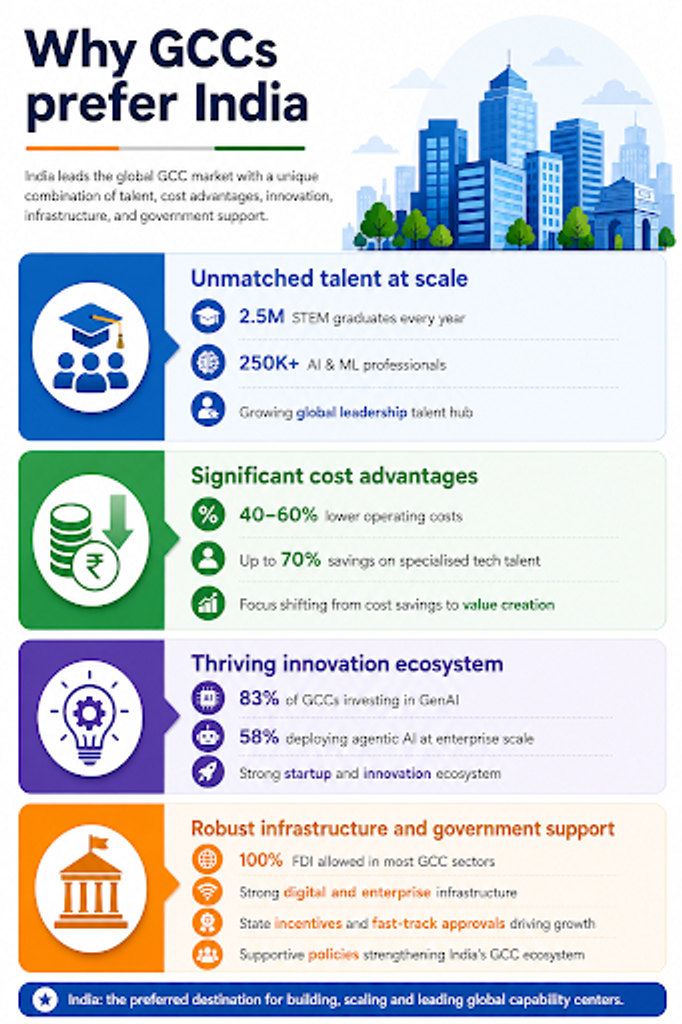
Unmatched talent at scale
India produces approximately 2.5 million STEM graduates every year, making it one of the largest talent pools in the world.
India is now the second-largest market for enterprise AI talent globally, with over 250,000 AI/ML professionals, per the NASSCOM-Zinnov GCC Landscape 2026 report. Strong expertise spans AI, data science, cloud computing, and product engineering at scale.
The leadership layer has evolved significantly. According to Zinnov's five-year GCC Landscape report, global leadership roles from India grew at a 40% CAGR over the past five years, reaching 6,500+ roles in 2024, including 1,050+ women leaders, up from just 115 in 2015. Companies are no longer building only execution teams in India. They are building leadership capability.
Significant cost advantages
Operating a GCC in India typically costs 40 to 60% less than in the US or Western Europe, with savings for specialised tech talent reaching up to 70%, according to Wisemonk.
To put that into perspective, a 50-member GCC in India may cost approximately $1.5 to $2 million annually, while a 200-member centre may cost $6 to $8 million. The same operations in Western markets would cost two to three times more.
The conversation has moved well beyond cost. Companies are no longer setting up GCCs in India purely for savings. They are using the cost advantage to build higher-value capabilities. The focus has shifted from cost arbitrage to value creation.
Thriving innovation ecosystem
The EY GCC Pulse Survey 2025 captures this shift clearly. 83% of GCCs in India are already investing in generative AI, and 58% have moved from experimentation to full enterprise-scale deployment of agentic AI. These are not pilot projects. They are production-level deployments reshaping how global enterprises operate.
Two-thirds of GCCs (67%) have created dedicated innovation teams and incubation platforms to generate and globalise ideas from India, with 92% of GCC leaders affirming that their centres now contribute well beyond cost arbitrage.
India's startup ecosystem further strengthens this positioning. Bengaluru continues to lead with one of the highest concentrations of tech startups globally. At the same time, Hyderabad's Telangana AI Mission has built partnerships with hundreds of startups to develop specialised capabilities in AI and life sciences.
Robust infrastructure and government support
India's policy environment has played a critical role in accelerating GCC growth.
The country allows 100% foreign direct investment through the automatic route in most GCC-relevant sectors, removing the need for prior government approvals. Major cities offer strong digital infrastructure, enterprise-grade connectivity, and mature business ecosystems.
State governments are actively competing to attract GCCs. Karnataka launched India's first dedicated GCC policy in 2024, targeting 500 new centres and 3.5 lakh jobs by 2029. Maharashtra has announced plans for 400 new GCCs by 2030, while Telangana, Gujarat, and Uttar Pradesh offer incentives ranging from payroll subsidies to fast-track approvals.
The Union Budget 2026 has further strengthened this momentum by raising the safe harbour threshold for transfer pricing from Rs 300 crore to Rs 2,000 crore, setting a uniform 15.5% margin for IT/ITeS services, and extending the cloud tax holiday to 2047.
Top GCC hubs in India: where should you set up?
While India as a whole is a strong GCC destination, location plays a critical role in how your centre performs.
Different cities offer different advantages, whether that is access to specialised talent, cost efficiency, infrastructure maturity, or industry alignment. The decision is less about which city is best overall and more about which city best fits your specific business needs.
India's GCC ecosystem divides broadly into tier-1 hubs and emerging tier-2 destinations.
Tier-1 cities: Established GCC powerhouses
These cities form the backbone of India's GCC landscape, with mature ecosystems, deep talent pools, and strong infrastructure.
Bengaluru
Bengaluru leads the GCC ecosystem, hosting around 880 GCC units, approximately 40% of India's total, per the JLL GCC Office Guide 2026. It offers the country's deepest talent pool in engineering R&D, AI, and product development, supported by a thriving startup ecosystem. It is the preferred choice for technology, R&D, and innovation-led GCCs.
Hyderabad
With 355+ GCCs, Hyderabad is one of India's fastest-growing hubs. Government-backed AI initiatives, combined with strong pharmaceutical and tech expertise, make it particularly attractive for healthcare, BFSI, and technology innovation centres. It also offers competitive operating costs relative to Bengaluru.
Pune
Pune has emerged as a strong option for manufacturing, automotive, and BFSI-led GCCs. It combines high-quality engineering talent with 15-20% lower costs than Bengaluru, making it a practical choice for companies balancing capability and cost efficiency.
Chennai
Chennai remains a reliable hub for engineering and IT services. Its strengths lie in automotive expertise, port connectivity, and a strong industrial base, making it particularly relevant for manufacturing and logistics-focused GCCs.
Mumbai
As India's financial capital, Mumbai is the natural choice for BFSI, consulting, and fintech GCCs. Its proximity to financial institutions and regulatory bodies gives it a distinct advantage for organisations operating in these sectors.
NCR region
NCR (Delhi, Gurgaon, Noida) serves as a major business hub with strong connectivity and access to international markets. It is particularly strong in analytics, e-commerce, and BFSI, with a growing base of enterprise operations.

Tier-2 cities: emerging GCC destinations
Alongside tier-1 hubs, tier-2 cities such as Coimbatore, Jaipur, Kochi, Ahmedabad, and Visakhapatnam are gaining traction.
These cities offer distinct advantages that complement a hub-and-spoke model:
- 15-25% lower operating costs compared to tier-1 locations
- Access to untapped talent pools with lower attrition rates than the major metros
- Improving infrastructure and active government incentives for new GCC setups
- A growing share of new GCC openings: tier-2 cities are expected to host around 39% of the GCC workforce by 2030, per Ceipal and Vestian
Many organisations are adopting a hub-and-spoke model, in which a primary GCC is established in a tier-1 city and supported by satellite operations in tier-2 locations. This approach optimises both cost and access to talent while building a more resilient, distributed operating model.
Step-by-step guide to setting up a GCC in India
Setting up a GCC in India is not a single-step process. It involves a series of decisions across strategy, legal structure, infrastructure, and talent.
While the process itself is fairly well-defined, execution is where most of the complexity arises, particularly when timelines, compliance, and scaling requirements intersect.
In practice, most GCC setups follow a structured, phased approach. A typical GCC can be set up within 12 to 24 weeks, depending on scale and execution speed. The process breaks down into four key phases.
Phase 1: Strategy and planning (weeks 1 to 4)
The first phase focuses on defining the role the GCC will play within your organisation.
This starts with a few core questions:
- What functions will the GCC handle?
- Is the goal cost efficiency, innovation, or both?
- How does the GCC align with the global business strategy?
- What is your target headcount and growth trajectory over three to five years?
Once this is clear, the next step is a feasibility study. This includes analysing talent availability, comparing location costs, assessing infrastructure, and identifying potential risks.
Location selection also happens at this stage, with companies matching city strengths to business requirements. Many organisations evaluate a hub-and-spoke model for added flexibility and cost optimisation.
In parallel, you choose an operating model. Options typically include:
- A wholly owned subsidiary (full control over entity, team, and intellectual property)
- Build-Operate-Transfer (BOT), where a partner builds and operates the centre before handing it over
- Managed GCC models, where a third party manages operations under your brand
- Virtual or hybrid models, which combine remote talent with a flexible workspace presence
Many organisations start with BOT or managed models and transition to fully owned structures as operations stabilise.
Phase 2: Legal entity formation (weeks 5 to 12)
Once the strategy is defined, the next step is to establish the legal entity.
Most GCCs in India are set up as Private Limited Companies under the Companies Act 2013, as this structure offers full ownership and operational control. Other options include Limited Liability Partnerships, or branch and liaison offices for an initial market presence.
The registration process typically involves:
- Obtaining a Director Identification Number (DIN)
- Acquiring a Digital Signature Certificate (DSC)
- Registering with the Ministry of Corporate Affairs (MCA)
- Ensuring compliance with the Foreign Exchange Management Act (FEMA)
This is followed by the tax and compliance setup: Permanent Account Number (PAN), Goods and Services Tax (GST) registration, Employees Provident Fund (EPF), and Employees' State Insurance (ESI).
Legal setup and compliance costs typically range from $10,000 to $25,000, according to Wisemonk's GCC cost benchmarks. Working with experienced legal advisors is critical at this stage, particularly for transfer pricing and compliance structures.
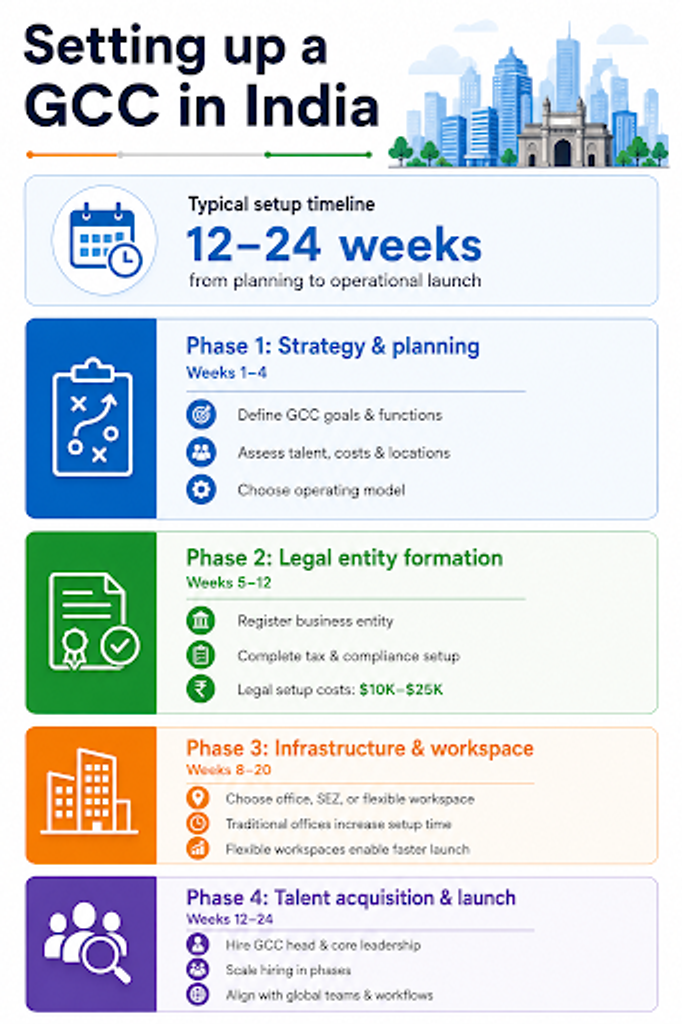
Phase 3: Infrastructure and workspace (weeks 8 to 20)
This is often the phase where GCC timelines slow down.
Traditional office setups in India involve long-term leases, significant security deposits, and fit-out timelines that can extend for several months. For organisations looking to move quickly, this becomes a critical bottleneck.
Companies typically evaluate three options: traditional office leases, Special Economic Zones (SEZs), and flexible workspace solutions.
For context, a traditional 50-seat office can cost Rs 200 to Rs 250 lakhs annually, while IT infrastructure and setup can add Rs 50 lakhs to Rs 2 crores. SEZs offer tax benefits but come with additional compliance obligations.
In 2025, GCCs secured 31.3 million sq ft of office space across India's top seven cities, representing 38% of total office leasing, the highest share ever recorded, per the JLL GCC Office Guide 2026. A growing proportion of that demand is being met through flexible workspace arrangements that eliminate the capital outlay and timeline risk of traditional fit-outs.
These solutions allow your team to become operational in days rather than months, while retaining the ability to scale as the team grows and redirecting capital towards talent and operations.
Phase 4: Talent acquisition and launch (weeks 12 to 24)
Once infrastructure is in place, the focus shifts to building your team and launching operations.
The first critical hire is typically the GCC head or India site lead. This role requires a combination of local expertise and global alignment, making it one of the most important early decisions you will make.
From there, hiring usually follows a phased approach:
- Start with a core team for critical functions
- Scale based on business milestones and budget cycles
- Align onboarding with global culture, processes, and ways of working
- Build the leadership pipeline early, particularly the India site lead and functional heads
Positioning matters here. GCCs positioned as innovation hubs rather than back-office units attract stronger talent and retain employees more effectively. Attrition across India's GCCs has fallen to 9% in 2025, down from 13% in 2023, per the EY GCC Pulse Survey 2025, reflecting stronger employer value propositions and retention strategies across the sector.
Operational go-live involves defining roles and responsibilities, establishing KPIs and governance structures, integrating with global teams and workflows, and communicating the GCC's mandate clearly to global stakeholders from day one.
Key challenges in setting up a GCC and how to overcome them
While the opportunity is significant, setting up a GCC comes with predictable challenges. Most of them are manageable with the right preparation.
Regulatory compliance complexity
India's regulatory framework includes labour laws, tax regulations, and data protection requirements such as the Digital Personal Data Protection Act.
The most effective way to manage this is to work with experienced legal advisors and establish a dedicated compliance function early in the process. The Union Budget 2026 has made some of this easier, raising the safe harbour threshold for transfer pricing from Rs 300 crore to Rs 2,000 crore and reducing compliance complexity for most mid-sized GCCs.
Talent acquisition and retention
Competition for specialised skills in AI, cloud, and cybersecurity remains high. That said, attrition across India's GCCs has improved markedly, falling to 9% in 2025 from 13% in 2023, per the EY GCC Pulse Survey.
To stay competitive, your team needs a strong employer value proposition, an investment in continuous learning, and a hiring strategy that includes tier-2 cities to access broader, often more loyal talent pools.
Cultural integration
Aligning GCC operations with the global headquarters can be challenging due to differences in working styles and communication patterns. This requires deliberate effort: regular leadership engagement, structured communication rhythms, and a hybrid culture that balances local context with global standards.
95% of GCCs have adopted hybrid work as the norm, according to the EY GCC Pulse Survey, making the cultural integration challenge both more visible and more manageable with the right policies in place.
Infrastructure and scalability
Traditional office setups can take 6 to 12 months and are difficult to scale quickly. Flexible workspace solutions address this challenge by enabling rapid deployment and providing infrastructure that grows with your organisation, without the upfront capital commitment or timeline risk of a conventional fit-out.
Future of GCCs in India: what's next?
The trajectory for GCCs in India remains strongly upward.
According to the JLL GCC Office Guide 2026, India is expected to host over 2,500 GCCs by 2030, employing 2.8 to 2.9 million professionals and generating over $105 billion in annual revenue.
Several trends are shaping this growth:
- Expansion into tier-2 and tier-3 cities, driven by cost advantages and access to untapped talent
- Rise of AI and automation: GCCs are increasingly operating as enterprise AI platforms rather than cost centres, with India becoming the world's primary hub for AI talent and deployment
- Sustainability as a mandate: ESG requirements are reshaping GCC KPIs and investment decisions across the sector
- Deeper global mandates: per the NASSCOM-Zinnov GCC Landscape 2026 report, 64% of GCC site leaders now hold dual mandates, combining global business unit ownership with site leadership, a clear sign that enterprise authority is migrating to India
This marks a clear shift: from offshore support centres to strategic global partners with real decision-making authority.
How WeWork India can accelerate your GCC journey
WeWork India operates 73+ centres across 8 cities, with a strong presence in every major GCC hub: Bengaluru, Hyderabad, Pune, Chennai, Mumbai, Gurgaon, Delhi, and Noida. For organisations setting up in India, this means immediate access to enterprise-grade infrastructure, private offices for teams of any size, dedicated desks, bookable meeting rooms for client-facing work, and a professional address in premium business locations.
For companies setting up a new GCC, WeWork India's Enterprise Solutions offer custom, scalable setups with all-inclusive pricing covering internet, housekeeping, community events, and amenities. You can scale up, scale down, or move locations as the team grows, without the friction of a traditional lease. Ready to set up your GCC in India? Explore GCC workspace solutions
Frequently asked questions
How is a GCC different from outsourcing?
In outsourcing, work is assigned to a third-party vendor who manages execution. In a GCC model, your company builds and manages its own team, retaining full control over operations, intellectual property, and long-term strategy. GCCs are typically used to build sustained capability, while outsourcing is used for specific deliverables.
How much does it cost to set up a GCC in India?
Legal setup and compliance typically cost between $10,000 and $25,000. Annual operating costs for a 50-member GCC range from $1.5 million to $2 million, while a 200-member centre may cost $6 million to $8 million. Operating costs in India are generally 40 to 60% lower than in the US or Western Europe, according to Wisemonk.
Which cities are best for setting up a GCC in India?
The choice depends on your GCC's focus. Bengaluru and Hyderabad are preferred for technology, product engineering, and AI-led centres. Pune and Chennai are strong for engineering and manufacturing. Mumbai suits BFSI and consulting, while NCR offers strengths in analytics and enterprise services. Tier-2 cities like Jaipur, Kochi, and Ahmedabad provide lower costs and emerging talent pools.
What industries are setting up GCCs in India?
GCCs in India span technology, banking and financial services, healthcare and pharmaceuticals, retail, manufacturing, automotive, and energy. The model is particularly relevant for organisations building long-term capability in product development, digital transformation, and global operations.
Related Blogs:

NEWS & INSIGHTS
The world of finance saw a drastic shift in its functional trajectory the moment it was hit by the wave of AI. Like all the other fields of commerce,

NEWS & INSIGHTS
The concept of flexible workspaces has changed the work landscape.

NEWS & INSIGHTS
In the evolving landscape of workplace design, the open office concept has gained significant popularity. This modern approach aims to foster collaboration, enhance flexibility