CULTURE & COMMUNITY
How to improve employee engagement in the workplace

WeWork Staff
August 27, 2026

Summarize this article with AI
What drives employee engagement in the workplace? This guide covers leadership, workspace design, recognition, and measurement strategies for HR leaders.
TL;DR
- Global employee engagement fell to 20% in 2025, costing the world economy an estimated $10 trillion in lost productivity, according to Gallup.
- Prioritising employee engagement in the workplace directly improves your overall profitability, reduces voluntary turnover, lowers absenteeism rates, and strengthens customer loyalty across every level of your organisation.
- Purposeful workspace design that incorporates natural light, ecocentric elements, acoustic zoning, and activity-based layouts strengthens employee engagement.
- WeWork India operates over 70+ locations across 8 cities, and offers engagement-focused workspaces with all-inclusive pricing and no lock-in commitment requirements.
Only about one in five employees globally feels engaged at work, according to Gallup’s State of the Global Workplace 2026. For organisations aiming to grow, this statistic reveals a gap between potential and performance. Improving employee engagement in the workplace is a strategic priority that directly shapes your bottom line.
Highly engaged employees are more likely to perform at their best, collaborate effectively, and stay with their organisation for longer. Yet many businesses struggle to improve engagement because they focus on isolated initiatives such as perks, benefits, or recognition programmes while overlooking one of the most influential factors: the workplace itself. The environment employees work in shapes how they collaborate, connect, and experience their organisation every day.
As workplace strategies continue to evolve, organisations are recognising that engagement is not driven by culture alone. It is shaped by a combination of leadership, purpose, flexibility, and thoughtfully designed workspaces that enable people to do their best work.
Whether you lead an HR function or oversee organisational strategy, you will find actionable insights to build a workplace where people genuinely want to contribute.
What is employee engagement, and why does it matter?
Employee engagement is the level of emotional and psychological commitment employees have towards their work, their team, and their organisation's goals. It influences how people approach their roles, solve problems, collaborate with colleagues, and contribute to business outcomes. Engaged employees do more than meet expectations - they take ownership, show initiative, and consistently invest discretionary effort in their work.
Employee engagement and employee satisfaction are conceptually distinct concepts. An employee may report satisfaction with tangible aspects of their role, such as compensation and working hours, while remaining emotionally disengaged from their work. Satisfaction measures comfort, while engagement measures connection, purpose, belonging, and the drive to go beyond the job description. When you conflate the two, you risk investing in surface-level perks that fail to drive the behaviours your organisation needs.
The global data underscores how widespread this challenge is. The economic toll is significant. Gallup estimates that low engagement costs the global economy approximately $10 trillion annually. Workspace disengagement numbers manifest as missed deadlines, stalled projects, rising absenteeism, and a steady erosion of a team's collective momentum.
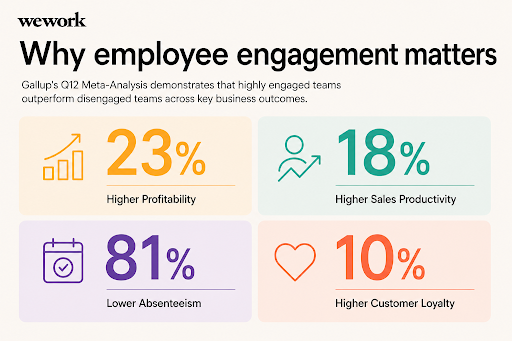
The business case for improving employee engagement is equally compelling. Gallup's Q12 Meta-Analysis found that highly engaged teams achieve 23% higher profitability, 18% higher sales productivity, 81% lower absenteeism, and 10% higher customer loyalty than disengaged teams. Organisations with high engagement also experience up to 51% lower employee turnover in low-turnover environments, reinforcing the link between employee engagement and sustained business performance.
Beyond the balance sheet, engagement shapes the lived experience of your workplace. When your people feel heard and connected to a larger purpose, they become advocates for your brand. They collaborate more willingly, mentor their peers, solve problems proactively, and choose to stay. In contrast, actively disengaged employees can erode morale and damage customer relationships from within.
For HR leaders, people managers, team leads, and CXOs, understanding the difference between satisfaction and engagement is the starting point. Building a truly engaged workforce requires intentional effort across leadership development, recognition systems, career growth pathways, and the physical workspace where your people spend their days. Creating a positive work environment that reflects these priorities is one of the clearest signals you can send to your team about how much you value their experience.
Key drivers of employee engagement
Employee engagement is shaped by a combination of organisational, managerial, and workplace factors. While engagement is often measured through surveys and performance metrics, improving it requires organisations to understand what influences employees' day-to-day experience at work.
These drivers rarely operate in isolation. Employees are more likely to feel engaged when they understand what is expected of them, feel recognised for their contributions, trust their leaders, and have the resources and environment needed to perform at their best. Focusing on a single initiative in isolation is unlikely to deliver lasting results. Instead, organisations need a holistic approach that strengthens multiple aspects of the employee experience.
Career growth opportunities give your people a reason to invest in the long term, while a sense of purpose connects daily tasks to outcomes that feel meaningful beyond a paycheck. When these elements work together, employees are far more likely to bring energy and commitment to their roles.
Two drivers deserve deeper attention because of their outsized impact on engagement outcomes: leadership quality and the physical workspace environment.
Leadership and manager quality
Your managers are the single most influential factor in determining whether your employees feel engaged or disconnected. According to Gallup's State of the Global Workplace report, managers account for 70% of the variance in team engagement scores. This statistic makes it clear that engagement is not primarily an HR initiative. It is a leadership responsibility that plays out in daily interactions.
Effective managers set clear expectations, provide consistent feedback, recognise contributions, and create psychological safety within their teams. They have regular one-on-one conversations that go beyond status updates to explore challenges, aspirations, development goals, and overall well-being.
Investing in manager development is one of the highest-leverage actions you can take. This means equipping managers with coaching techniques, providing them with actionable engagement data, building a culture of regular feedback, and holding them accountable for the experience their teams have every day. Effective managers also understand that the impact of the workplace environment on employee wellbeing, from lighting and acoustics to collaborative infrastructure, falls within their sphere of influence.
Workplace environment and office design
The physical space where your people work sends a powerful signal about how much you value their experience. A cramped, poorly lit office can erode engagement even when leadership and culture are strong. Conversely, a thoughtfully designed workspace can energise your team and reinforce a sense of purpose and belonging.
Research supports this connection. A Future Workplace study found that 78% of employees name access to natural light and views of the outdoors as the workplace attribute most directly tied to their well-being, ranking it above any other office feature. The workspace environment is not just about aesthetics. It directly affects concentration, collaboration, creativity, and overall well-being.
Activity-based working models, in which employees choose the setting that best suits their tasks, have emerged as a powerful approach to office design. Quiet zones for focused work, open areas for collaboration, dedicated meeting rooms for structured discussions, and informal common areas for spontaneous interaction give your people autonomy over how they work. This sense of control is itself a driver of engagement.
Organisations that treat workspace design as an afterthought miss a significant opportunity. Your office is not just a place to house desks. It is a tool that can actively support the behaviours, interactions, energy levels, and collaboration patterns that drive engagement. When your people walk into a space that feels intentional and well-equipped, they are more likely to bring their best selves to work.
Proven strategies to improve employee engagement
Understanding what drives engagement is only the first step. Translating that knowledge into consistent, organisation-wide action is where the real work begins.
The following strategies are grounded in research and designed to help you move from awareness to measurable improvement across every level of your organisation.
Transparent communication is the bedrock of trust, and trust is the foundation of engagement. When your people understand why decisions are being made, how their work connects to organisational goals, what changes lie ahead, and how those changes will affect their teams, they feel included rather than sidelined. Make communication a two-way practice by creating regular forums for dialogue. Town halls, skip-level meetings, anonymous feedback channels, team retrospectives, and structured one-on-one check-ins all give your people a voice.
The key is consistency: a sustained rhythm of open dialogue reinforces the message that every perspective matters. Research from Quantum Workplace shows that only 35% of employees feel their organisation effectively acts on the feedback they share, making visible follow-through one of the most important and most underdelivered communication commitments your leadership team can make.
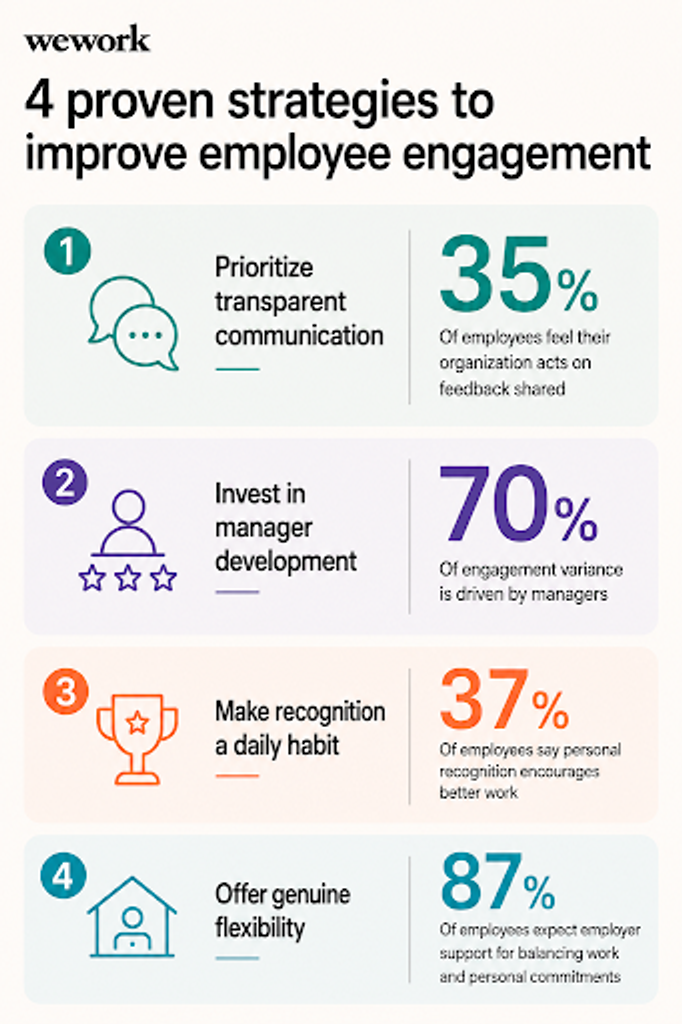
Manager development is equally critical because, as explored earlier, managers account for 70% of the variance in team engagement according to Gallup. Knowing this is not enough. You need to act on it by investing in structured coaching programs, equipping managers with real-time engagement data, creating feedback loops within their teams, and holding them accountable for the quality of their team's experience. Manager enablement should be treated as a continuous initiative rather than a one-time training session completed during onboarding.
Recognition programs offer one of the most cost-effective levers for improving engagement. According to Great Place to Work, 37% of employees say that more personal recognition is the single most important factor that would encourage them to produce better work. Recognition works best when it is timely, specific, visible across the organisation, and tied to clear behaviours.
Build it into your daily operations through peer-to-peer platforms, manager shout-outs during team meetings, milestone celebrations, and personalised appreciation messages. Treat recognition as a cultural habit rather than something reserved for annual performance reviews.
Flexible work arrangements have moved from a perk to an expectation. According to Glassdoor research, 87% of employees expect their employer to support them in balancing work and personal commitments. Offering choices in where, when, how, and on what terms your people work signals respect for their autonomy. Hybrid schedules, adjusted working hours, compressed workweeks, and location flexibility all contribute to a sense of trust that strengthens engagement over time.
Design workspaces that strengthen employee engagement
Employee engagement is shaped not only by leadership and organisational culture but also by the environments where people work every day. As organisations rethink how employees collaborate, focus, and connect, the workplace itself has become an important driver of engagement rather than simply a place where work happens.
Workspace design influences how teams interact, how easily they can concentrate, and whether employees feel supported throughout the working day. Factors such as access to natural light, acoustics, ergonomic furniture, meeting spaces, and quiet areas all contribute to the overall employee experience. While each element may seem incremental on its own, together they shape how people feel about coming to work and their ability to perform at their best.
The most effective workplaces are designed around different ways of working rather than a single office layout. Spaces for focused work, collaborative brainstorming, structured meetings, and informal conversations allow employees to choose the environment that best supports the task at hand. This flexibility encourages greater autonomy, reduces friction throughout the workday, and creates a stronger sense of ownership over how work gets done.
As workplace expectations continue to evolve, many organisations are taking a more intentional approach to office design. Rather than viewing the workplace as a fixed asset, they are treating it as part of their broader employee engagement strategy, creating environments that support collaboration, wellbeing, and organisational culture while adapting to changing business needs.
Creating workspaces that reflect your organisation
Designing an engaging workplace requires more than selecting furniture or planning floor layouts. It involves creating spaces that reflect how your teams work, collaborate, and grow. This includes everything from spatial planning and movement between work zones to materials, branding, and workplace experiences that reinforce the organisation’s culture and vision.
How workspace design impacts employee engagement
The relationship between your physical environment and employee engagement runs deeper than aesthetics or comfort. Research in environmental psychology consistently shows that spatial design influences mood, cognitive function, stress levels, and interpersonal dynamics. When you approach workspace design as a strategic lever rather than a logistical necessity, you unlock a powerful and often underutilised channel for strengthening engagement.
The science behind biophilic design
Biophilic design integrates natural elements such as plants, water features, natural materials, and views of greenery into the built environment. Research cited in the World Green Building Council's Health, Wellbeing and Productivity in Offices report has found that incorporating biophilic elements into office environments can reduce sick days by up to 30%. For an organisation with hundreds or thousands of employees, a reduction of this scale translates directly into higher productivity, lower healthcare costs, improved morale, and more consistent team output.
The Human Spaces report by Interface, which surveyed more than 7,600 employees across 16 countries, adds further evidence: employees in offices with natural elements report 15% higher creativity than those in spaces without them. Natural elements also help reduce mental fatigue, improve concentration, support creative thinking, and restore attention capacity. When your people work in spaces that feel alive and connected to nature, they experience lower cortisol levels and greater emotional resilience throughout the day.
How light and spatial layout shape daily experience

Natural light is one of the most impactful and most overlooked elements of workspace design. According to the World Green Building Council, optimising access to natural light can boost productivity by up to 18%. Beyond the productivity benefits, access to daylight helps regulate circadian rhythms, improving sleep quality, energy levels, mood, and overall well-being. Employees positioned near windows or in well-lit environments tend to report higher satisfaction with their workspace and a stronger sense of connection to their organisation.
Spatial layout matters just as much. The way you configure pathways, workstations, meeting rooms, and shared areas determines how often your people encounter one another, how easily they transition between focused work and collaboration, how naturally ideas flow between teams, and how much control they feel over their environment. Open layouts without sufficient acoustic zoning can lead to distraction, while overly enclosed layouts can breed isolation. The most effective designs balance openness with privacy, giving your people agency over their daily rhythm.
Brand expression and cultural identity
Your workspace is also a canvas for your organisational identity. The workplace communicates what an organisation stands for through its design, branding, and the experiences it creates, reinforcing culture in ways that internal communications alone cannot.
Elements such as colours, materials, artwork, spatial planning, and shared collaboration areas all contribute to a stronger sense of identity and belonging. When employees see their organisation's values reflected in the workplace, it helps create a more consistent employee experience and strengthens their connection to the business.
For organisations investing in long-term employee engagement, workplace design has become an important way to bring culture to life.
Rivet by WeWork India works with organisations to translate brand values into tangible spatial experiences. Whether it is creating collaborative neighbourhoods that reflect your team structure or designing wellness zones that signal your commitment to employee health, the physical environment becomes an extension of your culture. Research on the impact of the workplace environment on employee well-being confirms that intentionally designed spaces consistently outperform standard offices in engagement, retention, and daily energy.
The takeaway for HR leaders and CXOs is clear: workspace design is not a one-time capital expense. It is a continuous investment in the conditions that make engagement possible. When your people feel that their environment was designed with their needs in mind, engagement follows naturally.
Design a workspace that drives engagement
Rivet by WeWork India helps enterprises design and build offices tailored to their culture, team dynamics, and engagement goals. Visit rivet.co.in
How to measure employee engagement
You cannot improve what you do not measure. Effective engagement measurement goes beyond running an annual survey and reviewing a single score. It requires the right combination of tools, a consistent cadence, genuine follow-through, and a commitment to acting on what you learn.
Engagement surveys remain the most widely used method for understanding how your people feel about their work, managers, environment, and growth opportunities. Annual surveys provide a comprehensive baseline, while quarterly or monthly pulse surveys help you track sentiment shifts between larger assessments.
The key to survey effectiveness lies not just in asking the right questions but in closing the loop. Research from Quantum Workplace shows that 35% of employees feel their organisation does not effectively act on feedback. When your people invest time in providing honest feedback and see no visible change, trust erodes and future participation declines.
Employee Net Promoter Score (eNPS) offers a focused measure of loyalty and advocacy. By asking your people how likely they are to recommend your organisation as a place to work, you gain a single metric that captures overall sentiment. Monitoring eNPS over time reveals whether your engagement initiatives are gaining momentum or losing traction.
Turnover rates and absenteeism data provide behavioral signals that complement attitudinal survey findings. A spike in voluntary departures within a specific team or department often reveals engagement problems that surveys alone may not surface. Similarly, rising absenteeism can indicate burnout, low morale, disengagement, or dissatisfaction with the work environment.
The most effective measurement strategies combine quantitative data from surveys and workforce metrics with qualitative insights gathered through one-on-one conversations, exit interviews, retention interviews, and manager observations. When you layer these inputs together, you build a more complete and actionable picture of where engagement stands across your organisation.
Build a workplace where people want to be
Employee engagement in the workplace is not a single initiative or a box to check during annual reviews. It is the cumulative result of how your leaders interact with their teams, how your organisation recognises contributions, how you invest in career growth, and how your physical environment supports daily work. The data is clear: engaged teams outperform disengaged ones across every meaningful business metric. Your ability to attract, retain, energise, and develop talent depends on how deliberately you invest in the conditions that enable engagement.
WeWork India understands that workspace design is a strategic engagement tool, not a logistical afterthought. With over 70 locations across 8 cities, WeWork India provides flexible workspace solutions with all-inclusive pricing and no lock-in commitments. Rivet by WeWork India takes this further by partnering with organisations to design and build workspaces tailored to their culture, team dynamics, growth priorities, and engagement objectives.
The organisations that will win the talent race are the ones that treat workspace design as a strategic priority rather than an operational expense. Your next step toward building a workplace where people genuinely want to contribute starts with rethinking the environment itself. Explore workspace options to discover how WeWork India can help you create a workspace that drives lasting engagement.
Ready for an office that drives engagement?
WeWork India provides flexible workspace solutions with all-inclusive pricing, no lock-in commitments, and 73+ locations across 8 Indian cities. Visit wework.co.in/enterprise
Frequently asked questions
What is employee engagement, and why is it important?
Employee engagement refers to the emotional and psychological commitment your people feel toward their work, their team, their environment, and your organisation's goals. It matters because engaged teams experience higher profitability, productivity, lower absenteeism, and lower attrition.
What are the top strategies to improve employee engagement?
Key strategies include transparent communication, manager development, recognition programs, and purposeful workspace design. Flexible work arrangements and activity-based office layouts also play an important role in giving employees autonomy and reinforcing trust across teams.
How does office design affect employee engagement?
Thoughtful office design incorporating natural light, biophilic elements, acoustic zoning, and activity-based layouts directly influences mood, focus, productivity, and collaboration.
What role do managers play in employee engagement?
Effective managers set clear expectations, provide consistent feedback, recognise contributions, and create psychological safety within their teams. Investing in manager development is one of the highest-leverage actions an organisation can take.
How do you measure employee engagement effectively?
Effective measurement combines engagement surveys, Employee Net Promoter Score (eNPS), turnover rates, and absenteeism data. Annual surveys paired with quarterly pulse surveys help track sentiment over time, while qualitative insights from one-on-one conversations, exit interviews, stay interviews, and manager observations complete the picture.
What is the difference between employee engagement and employee satisfaction?
Employee satisfaction measures comfort with factors such as salary, benefits, and work hours. In contrast, engagement measures emotional commitment, purpose, a sense of belonging, and the drive to go beyond the job description. An employee can be satisfied yet disengaged, which is why organisations need to track both dimensions to accurately understand their workforce.
Can workplace redesign improve employee retention?
Yes. Thoughtful workspace design that supports different work styles, incorporates natural elements, promotes collaboration, and reflects your organisational values creates a stronger sense of belonging. This deeper connection to the physical environment directly reduces voluntary turnover over time.
Related Blogs:

CULTURE & COMMUNITY
Many professionals now deal with stress regularly, with tight deadlines and long work hours in a stressful workplace. In such a demanding and fast-paced work culture, mindfulness can be an effective strategy.
CULTURE & COMMUNITY
A buddy system involves assigning a new employee a coworker buddy. The buddy, who is an experienced worker, guides the new employee for the first weeks or months of work.
CULTURE & COMMUNITY
In this blog, we will understand the meaning of workplace flexibility, its benefits, and learn how coworking workplaces like WeWork can help in embracing flexibility in the workplace.