CULTURE & COMMUNITY
Workplace Culture: What It Is, Why It Matters & How to Build It

WeWork Staff
June 21, 2024

Summarize this article with AI
Learn the importance of workplace culture and despite the diversity in the workplace how to create a great workplace environment for your employees with Wework.
TL;DR
- Workplace culture is the shared values, behaviours and everyday norms that define how your team works, makes decisions and treats one another.
- This guide covers the main types of workplace culture across Indian organisations, along with the signs of a toxic environment to watch for before damage becomes structural.
- You will learn how to measure culture health using pulse surveys, retention data and an honest gap analysis between your stated values and what your team actually experiences.
- The right workspace, hybrid policies and leadership habits work together to build a culture your people want to stay for. WeWork India operates 70+ centres across India's major cities to support exactly that.
In India, where hybrid work and distributed teams are now standard across sectors, getting workplace culture right has become a clear competitive differentiator. Workplace culture influences everything from how new hires settle in on day one to how customers experience your brand from the outside. Gallup research shows that employees strongly connected to their workplace culture are 4.3x more likely to be engaged and 62% less likely to feel burned out.
This guide covers the main types of workplace culture found across Indian organisations, the early warning signs of a toxic environment and a practical framework to measure and improve culture over time. You will also see how your physical workspace, hybrid policies and leadership habits shape the culture your team actually lives every day.
What is workplace culture?
Workplace culture is the shared set of values, behaviours, attitudes and everyday norms that define how people work together inside your organisation, shaping everything from how new hires settle in to how customers experience your brand.
It is the answer to a simple question: "How do we do things around here?"
Culture shows up in the small moments: how a manager responds to a missed deadline, whether people speak up in town halls, and how new joiners are welcomed on day one. It is both formal, your stated values, policies and rituals, and informal, the conversations in the pantry and the side chats after a review.
Crucially, culture is not what you say on your careers page. It is what your team experiences every single day. It is the cumulative effect of everyday inputs, including leadership behaviour, core values, hiring and onboarding, communication norms, rituals and rewards, and physical environment working together.
Workplace culture, company culture and organisational culture
| Term | Focus |
|---|---|
| Workplace culture | Day-to-day employee experience How people interact, collaborate and feel at work |
| Company culture | Brand-led identity The mission, values and personality your company projects internally and externally |
| Organisational culture | The academic term Broader systems, structures and norms that shape behaviour at scale |
Types of workplace culture
No two organisations have identical cultures, but most fall into a handful of recognisable patterns. Knowing which type you have and which you are aiming for helps you make smarter calls on hiring, leadership and office design:
1. Collaborative culture
Teams work cross-functionally, decisions are shared, and ideas flow openly across levels. You will find this in early-stage startups, design studios and product teams where speed and creativity depend on constant conversation. If your team is looking for shared space to work and connect, explore WeWork India's coworking spaces.
2. Innovative culture
Experimentation is rewarded, and failure is treated as a learning signal. R&D-led companies, deep-tech startups and creative agencies thrive here and tend to invest heavily in spaces that encourage spontaneous collaboration.
3. Results-driven culture
Performance, targets and outcomes drive everything. Sales-led businesses, high-growth scale-ups and consulting firms often run this way, with clear KPIs and visible recognition for top performers.
4. Process-led culture
Structure, compliance and consistency take priority. You will see this in banking, insurance, healthcare and other regulated industries where predictability matters more than improvisation.
5. Purpose-driven culture
The mission comes first, and every decision is measured against it. Social-impact ventures, climate-tech companies and mission-led brands attract employees who want their work to mean something beyond a paycheck.
6. Hybrid culture
A culture intentionally built for distributed teams, with norms around asynchronous communication, documented decisions and inclusive meetings baked into how the team operates. For most growing Indian companies in 2026, this is increasingly the default.
In reality, most organisations are a blend of two or three of these: collaborative and results-driven, or purpose-driven and hybrid. The goal is to be intentional about which behaviours you want to amplify and which you want to dial back.
Benefits of good workplace culture
Culture is not a "soft" topic any more. It directly shapes engagement, retention, performance and your ability to hire, all of which roll up into business outcomes your CFO cares about.
Here is where that impact shows up most clearly in your business:
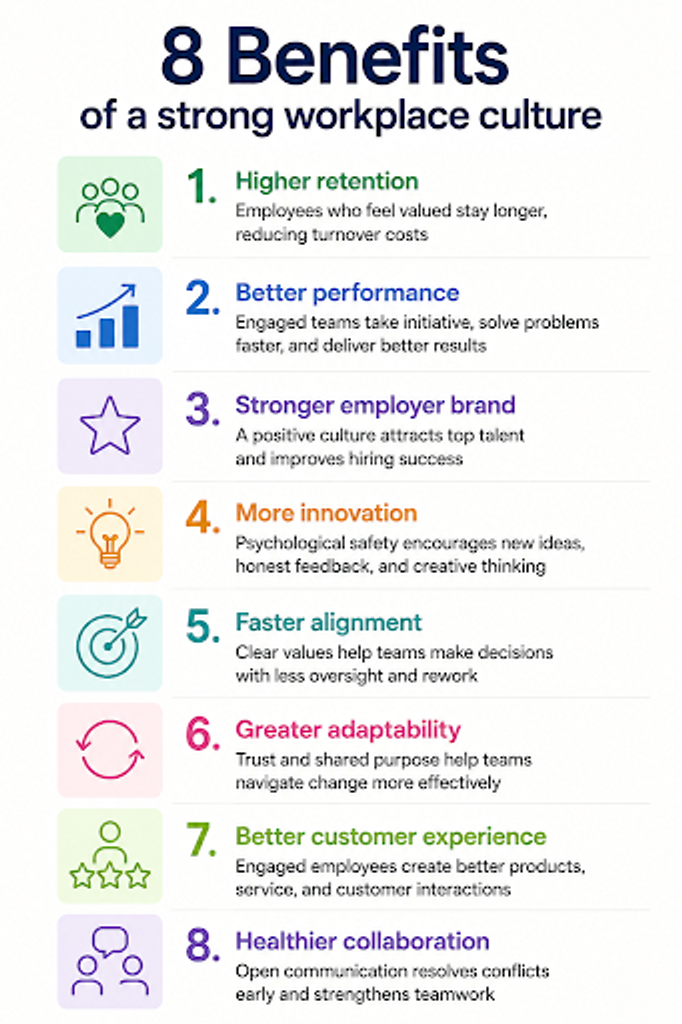
1. Employee satisfaction and retention
When your team feels respected, heard and aligned with what your company stands for, they stay. SHRM research puts the cost of replacing an employee at six to nine months of their salary, making culture one of the most cost-effective retention strategies available to any company.
2. Productivity and performance
People who believe in the way their company works put in discretionary effort, solving problems without being asked and mentoring peers. Gallup's meta-analysis of more than 183,000 business units found that highly engaged teams are 14% more productive than disengaged ones.
3. Hiring and employer brand
Candidates research your culture before they apply. Glassdoor research shows 83% of job seekers check a company's reviews and ratings before deciding where to apply, shaping who walks through your door and who does not.
4. Collaboration and innovation
A culture of psychological safety makes it safe to share half-formed ideas or admit a mistake early. Google's two-year Project Aristotle study of 180 teams found psychological safety was the single biggest factor separating its highest-performing teams from the rest.
5. Adapting to change
Whether it is a funding round, a pivot, or a shift to hybrid work, companies with a strong culture absorb change more quickly. Deloitte's 2025 Global Human Capital Trends research found the average worker now faces ten planned enterprise changes a year, up from two in 2016.
6. Brand reputation and customer experience
Your team's experience inside leaks into your customer's experience outside. Gallup research shows highly engaged teams deliver 10% higher customer loyalty and engagement than disengaged ones.
Building culture for India's diverse workforce
India is a diverse nation with over 22 official languages. Teams spanning tier-1 to tier-3 cities and generational gaps are a structural reality your workplace needs to account for. O.C. Tanner Institute's 2026 research shows inclusive teams are 7x more likely to be innovative and 10x more likely to do great work.
This takes deliberate team design across regions and experience levels, and product and support decisions shaped by people who reflect the customers you serve. Representation is not the same as inclusion: rotating meeting facilitators and structured feedback cycles turn representation into genuine participation. Read our piece on how to end bias in the office for practical steps.
Signs of a toxic workplace culture
Toxic culture rarely arrives with a warning label. It builds slowly through small, ignored signals that compound until your best people quietly start looking elsewhere. Spotting the early signs gives you a chance to course-correct before damage becomes structural.
1. High turnover and burnout
When regretted attrition climbs and exit conversations start sounding the same, that is a culture signal. Persistent burnout, people working weekends, skipping leave and going quiet in meetings usually point to unrealistic expectations or unclear priorities at the top.
2. Low psychological safety
If your team hesitates to share dissenting views, flag risks early or admit mistakes. You will see it in meetings where only senior voices speak, in retros that surface nothing useful and in problems that only emerge after they have become expensive.
3. Poor communication from leaders
Vague decisions, last-minute pivots, and information shared only with an inner circle erode trust quickly. When your team does not know what is happening or why, they fill the gaps with speculation and a slide in morale.
4. Cliques and exclusion
Watch how people gather in your common areas. If certain groups always sit together, certain voices dominate every project, and new joiners struggle to break in, you have an inclusion problem dressed up as "team chemistry."
5. Micromanagement and low trust
Approval bottlenecks, constant status check-ins and managers rewriting work instead of coaching are all signs that autonomy is not really on offer. Talented people recognise this fast and leave.
6. Little recognition or growth
When wins go unnoticed, and career conversations only happen at appraisal time, your team starts to feel invisible. Recognition is not just about bonuses. It is about whether people feel their effort is recognised by the people they work for.
How to measure workplace culture
You cannot improve what you do not measure, and measuring culture does not require a six-figure consulting engagement, just consistency, honesty and the willingness to act on what you find.
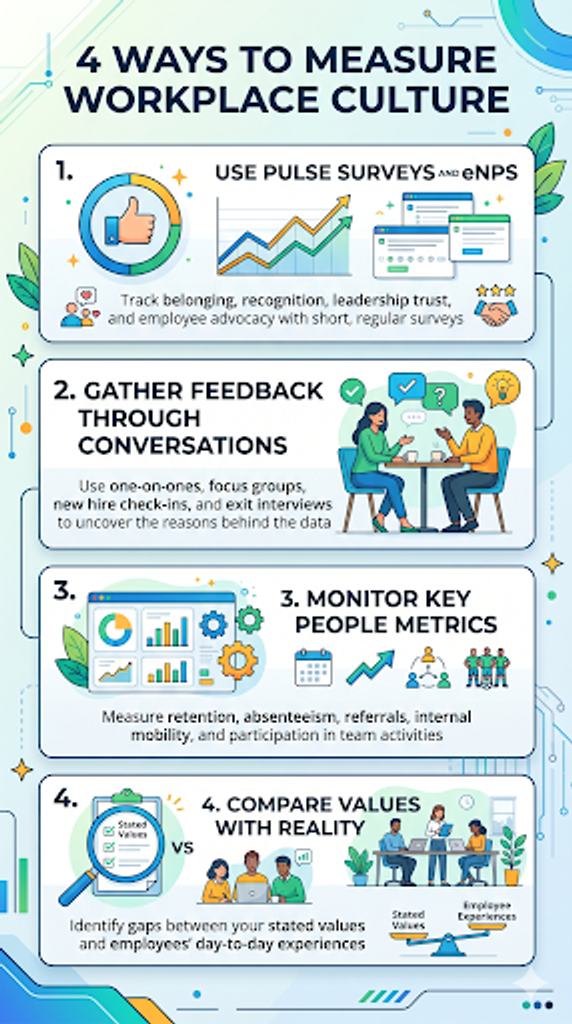
1. Use pulse surveys and eNPS
Short, frequent pulse surveys beat annual engagement marathons. Ask three to five focused questions every month or quarter covering belonging, clarity, recognition and leadership trust, then track movement over time. Layer in an employee Net Promoter Score: "How likely are you to recommend us as a place to work?"
2. Gather feedback through check-ins and focus groups
Surveys give you the what; conversations give you the why. Train your managers to run genuine one-on-ones, not status updates, and host quarterly focus groups by team, level and tenure. New joiners at the 90-day mark and exiting employees are two of the most honest sources of insight you will find.
3. Track retention, absenteeism and internal mobility
The numbers tell a clear story. Watch your regretted attrition, sick leave patterns, internal transfer requests, referral rates, and participation in optional team rituals. A healthy culture shows up as people choosing to stay, refer friends and apply for internal roles.
4. Compare stated values with lived experience
Take each of your stated values and ask your team: "Where do you see this lived? Where do you see it violated?" The gap between what is on your wall and what your people experience is the real culture map and the real to-do list.
A simple framework to anchor the work:
● Define the culture you want in specific behaviours.
● Measure the current experience honestly.
● Spot the biggest gaps between stated values and lived reality.
● Act and review every quarter, not once a year.
Strategies for building a positive workplace culture
Building a positive workplace culture is a series of small, consistent decisions made by leaders, managers and teams every week. Here is what actually moves the needle.
- Define and communicate core values and be specific enough to guide a hard call. Reinforce them in hiring, onboarding, performance reviews and the stories you tell at all-hands meetings.
- Lead by example. If you say well-being matters but reward people who reply at midnight, the midnight behaviour wins. Founders and senior leaders set the ceiling for what is normal across the whole organisation.
- Foster inclusion in the daily work to make sure every voice is heard, every background is represented, and every team ritual is genuinely welcoming. Read our piece on how to end bias in the office for practical steps.
- Encourage open communication. Run skip-level conversations, anonymous question boxes for town halls and retrospectives that focus on systems.
- Recognise and reward contributions, timely and public. A two-line shout-out tied to a company value beats a generic annual award every time. It also costs nothing.
- Support work-life balance and offer real flexibility: hybrid schedules, focused work time and leave that people are actually encouraged to take. Pair every employee with a clear growth path.
- Invest in thoughtful common areas that spark conversations across teams; well-designed meeting rooms make collaboration easier, and a welcoming pantry becomes the unofficial culture hub. Learn more in our piece on rethinking workspaces.
Workplace culture trends in India (2026)
Workplace culture in India is undergoing a serious reset. Hybrid is now the norm, Gen Z is rewriting expectations, and the office has shifted from a place you have to be to a place you choose to be.
1. Hybrid work is reshaping team norms
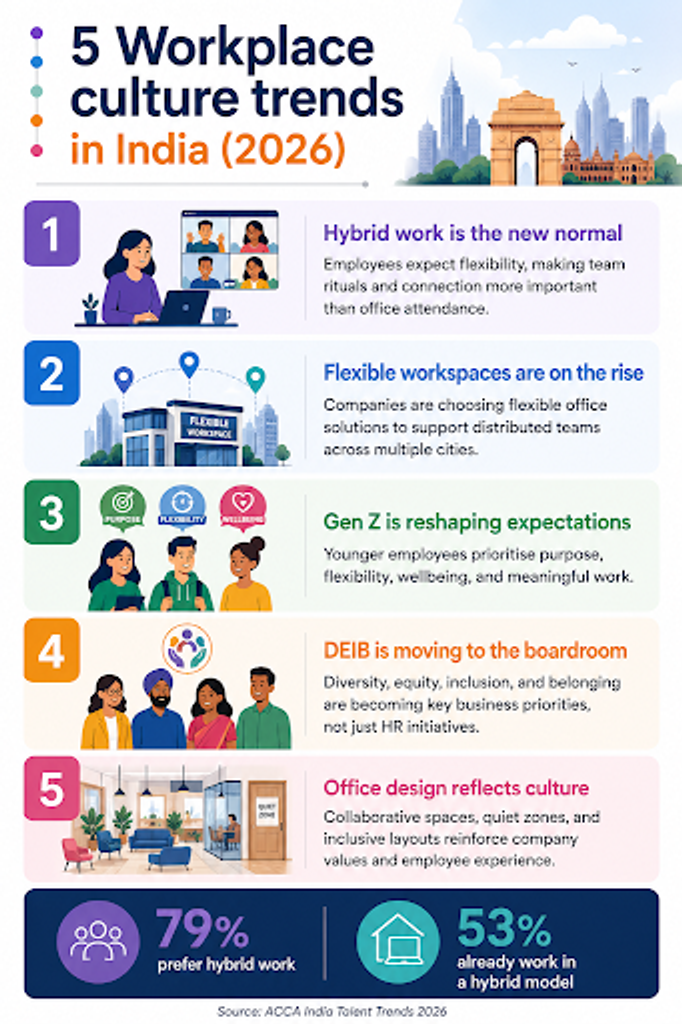
The five-day office week is gone for most knowledge teams. According to ACCA Global's Talent Trends 2026, 79% of respondents in India prefer a hybrid working pattern, and 53% are already working in one, reshaping how teams build connection across distributed locations.
The new challenge is designing rituals, such as weekly team days and quarterly offsites, that build connection without forcing presence. Read more on workplace flexibility and how to make it work for your team.
2. Flexible workspace solutions support distributed teams
Indian companies are increasingly choosing flexible office space in India over long, rigid leases, giving distributed teams across major cities access to the same brand-managed environment. Your youngest hires want to know what your company stands for, and DEIB is moving from an HR initiative to a board-level conversation. Open common areas signal collaboration, quiet zones signal respect for focus, and accessible meeting rooms signal that every voice gets a seat.
If you are rethinking how your physical workspace can support this shift, explore WeWork India's locations across the country.
Build a workplace culture your team loves
Your culture is built in the everyday decisions, conversations and environments your team moves through. Every feedback conversation, every ritual and every design choice in your workspace either reinforces or quietly contradicts the values you say you stand for.
WeWork India operates 70+ centres across Bengaluru, Mumbai, Delhi-NCR, Hyderabad, Pune, Chennai and Gurgaon, giving growing companies access to thoughtfully designed workspaces that support collaboration, focus and the kind of environment people genuinely want to show up for.
Explore WeWork India's flexible workspace solutions or talk to our team about enterprise workspace solutions designed for growing, distributed teams.
Frequently asked questions
1. What is meant by workplace culture?
Workplace culture is the shared set of values, beliefs, behaviours and unwritten rules that shape how people work together inside an organisation, from how decisions get made to how feedback is delivered and how new joiners are welcomed.
2. What are the different types of workplace culture?
The most common types are collaborative, innovative, results-driven, process-led, purpose-driven and hybrid. Most organisations are a blend of two or three rather than a single type, and the goal is to be intentional about which behaviours you want to amplify.
3. Why is workplace culture important for employees?
A positive workplace culture directly affects how engaged, motivated and supported your employees feel. It influences retention, mental well-being, career growth and the quality of relationships at work, which is why culture is consistently cited as a top factor in where talented people choose to stay.
4. What are the signs of a toxic workplace culture?
Key warning signs include high turnover and persistent burnout, low psychological safety, poor communication from leadership, visible cliques and exclusion, micromanagement and a lack of recognition or clear career growth opportunities.
5. How do you build a positive workplace culture in India?
Start by defining clear values, hiring against them and modelling them from the top. Combine that with inclusive practices for India's linguistic and regional diversity, flexible work policies, regular feedback loops and a physical workspace that supports both focus and collaboration.
6. How does the physical office environment affect workplace culture?
Your office quietly shapes behaviour every day. Open common areas encourage cross-team conversations, well-designed meeting rooms make collaboration easier and thoughtful amenities signal that you care about your team's experience, all of which reinforce the values you want lived.
Related Blogs:

CULTURE & COMMUNITY
Many professionals now deal with stress regularly, with tight deadlines and long work hours in a stressful workplace. In such a demanding and fast-paced work culture, mindfulness can be an effective strategy.

CULTURE & COMMUNITY
A buddy system involves assigning a new employee a coworker buddy. The buddy, who is an experienced worker, guides the new employee for the first weeks or months of work.
CULTURE & COMMUNITY
In this blog, we will understand the meaning of workplace flexibility, its benefits, and learn how coworking workplaces like WeWork can help in embracing flexibility in the workplace.