SUSTAINABILITY IMPACT
Sustainable office design: a practical guide to building eco-friendly workplaces

WeWork Staff
August 27, 2026
Summarize this article with AI
Discover practical strategies for sustainable office design in India. This guide covers certifications, materials, energy systems, and trends for 2026.
TL;DR
- Green-certified offices achieve energy savings of 20-30% and water savings of 30-50% compared to conventional workspaces, according to the Indian Green Building Council.
- Investing in sustainable office design now protects your business from rising energy costs, tightening regulatory requirements, shifting employee expectations, and growing investor scrutiny later.
- Choose sustainable materials based on lifecycle cost rather than purchase price alone, and integrate smart technology during the initial design phase rather than retrofitting it in.
- WeWork India, which operates 70+ centres across eight cities, along with Rivet by WeWork India, its design-and-build vertical, both deliver sustainable office design through streamlined coordination and all-inclusive pricing that reduces costs by 25-30%.
Sustainable office design combines energy-efficient systems, responsible material choices, biophilic elements, water conservation, and smart technology to reduce environmental impact while improving occupant wellbeing and operational performance.
The construction sector accounts for nearly 40% of global energy-related CO2 emissions, according to the World Green Building Council, and Indian businesses navigating rapid growth are exposed to that footprint more directly than most. Sustainable office design offers a way to reduce it while also improving operational performance and employee wellbeing, which is why the business case for it is becoming difficult to ignore.
Green-certified workspaces lower energy costs, improve indoor air quality, attract top talent, and strengthen your brand with environmentally conscious clients and investors. As India's regulatory framework around energy efficiency tightens, companies that invest in sustainable design today are also building resilience against future compliance costs and carbon-related reporting requirements.
This guide breaks down the core principles of sustainable office design, the certification pathways relevant to India, practical implementation steps, and the trends shaping 2026. Whether you are planning a new office fit-out or upgrading an existing space, you will find strategies grounded in real-world Indian market practice.
What is sustainable office design?
Sustainable office design is an approach to planning, constructing, operating, and maintaining workspaces that minimises environmental impact while maximising occupant wellbeing and long-term operational efficiency. It goes beyond superficial changes like adding a few indoor plants or switching to LED bulbs, a genuinely sustainable approach addresses every element of your workspace systematically, from the materials specified during fit-out to the systems that manage energy and air quality day to day.
At its core, sustainable office design rests on four interconnected pillars. Energy efficiency comes first, since it is usually the highest-impact starting point: smarter lighting, optimised climate control, improved insulation, and efficient equipment choices all reduce the energy your workspace consumes, which matters because India's commercial sector is among the fastest-growing energy consumers in the country, per the Bureau of Energy Efficiency (BEE).
Material selection follows closely behind, prioritising responsibly sourced, low-toxicity, durable, and recyclable inputs such as FSC-certified wood, low-VOC paints, bamboo, recycled metals, and reclaimed finishes. These choices directly affect both indoor air quality and the embodied carbon of your fit-out, giving them consequences that extend well past the day the office opens.
That air quality, along with natural lighting, thermal comfort, and acoustic performance, makes up indoor environmental quality, the pillar that shapes how your teams actually feel and perform each day. The evidence for this is substantial: employees in green-certified buildings score 26% higher on cognitive function tests and report 30% fewer sick building symptoms than those in conventional offices, according to research from the Harvard T.H. Chan School of Public Health.
The fourth pillar, waste reduction, is where sustainability extends beyond the fit-out itself. Designing for longevity, modularity, adaptability, and recyclability from the outset, alongside construction waste management and operational recycling programmes, keeps a sustainable office out of landfill throughout its entire lifecycle, including the furniture and fixtures it eventually replaces.
These four pillars are codified in recognised frameworks such as LEED (Leadership in Energy and Environmental Design), India's own IGBC (Indian Green Building Council) rating system, GRIHA (Green Rating for Integrated Habitat Assessment), and the Energy Conservation Building Code (ECBC). Each framework provides measurable benchmarks, letting you set targets, monitor progress, and validate your sustainability efforts through independent audits. WeWork India's guide on the latest office space design trends is a useful companion if you want to see how these principles translate into real workspace design choices.
Why sustainable office design matters for Indian businesses
India now has the second-largest certified green footprint in the world, with over 10 billion square feet of registered green projects according to the IGBC. Yet most commercial offices still operate without formal sustainability frameworks, which leaves Indian businesses facing both a strategic opportunity and a growing risk as regulatory requirements, energy costs, and employee expectations continue to rise.
Cost reduction is the most immediate benefit. The IGBC puts energy savings at 20-30% and water savings at 30-50% for green-certified offices compared to conventional workspaces, and once reduced maintenance expenses and longer equipment lifespans are factored in, the operational savings often recover your initial investment within four to five years.
Employee wellbeing and productivity follow directly from a better workplace environment. The World Green Building Council finds that offices with enhanced air quality, optimised natural lighting, and effective thermal control can boost employee productivity by up to 11%, and in a competitive talent market, your workspace also communicates your values to prospective hires before you say a word about them.
Regulatory alignment is becoming harder to defer. The Energy Conservation Building Code, administered by the Bureau of Energy Efficiency, sets progressively stricter standards for commercial properties across India, and multiple state governments now offer incentives, including additional floor area ratio (FAR) allowances and reduced property tax rates, for green-certified projects. Designing for compliance today protects your business from costly retrofits and penalties down the line.
For ideas on how workspace design choices connect to team performance, WeWork India's guide on innovative office design ideas covers some of the approaches Indian businesses are adopting.
5 key elements of sustainable office design
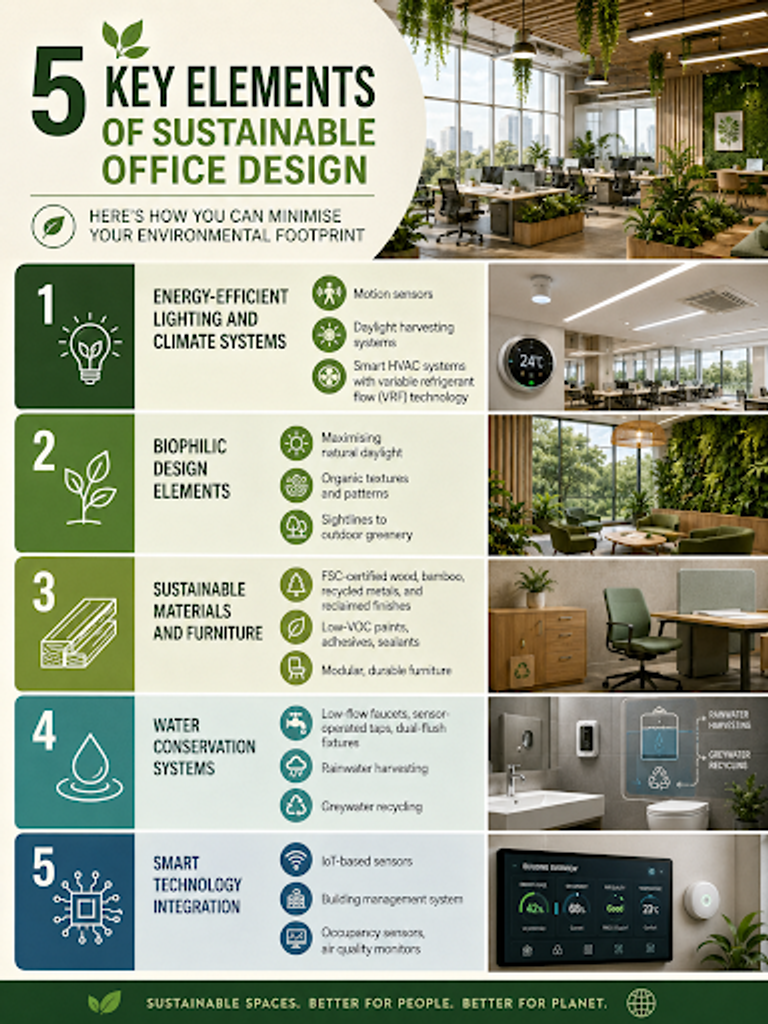
Moving from principles to practice, your sustainable office design strategy should address five interconnected elements, each reducing your environmental footprint while creating a healthier, more productive workspace.
1. Energy-efficient lighting and climate systems
Lighting alone accounts for over 30% of energy consumption in India's commercial offices, per the BEE, which makes upgrading to LED fixtures the most direct first step, though a complete strategy goes further. Motion sensors and daylight harvesting systems adjust artificial lighting based on occupancy and available natural light, preventing unnecessary energy use throughout the day.
2. Biophilic design elements
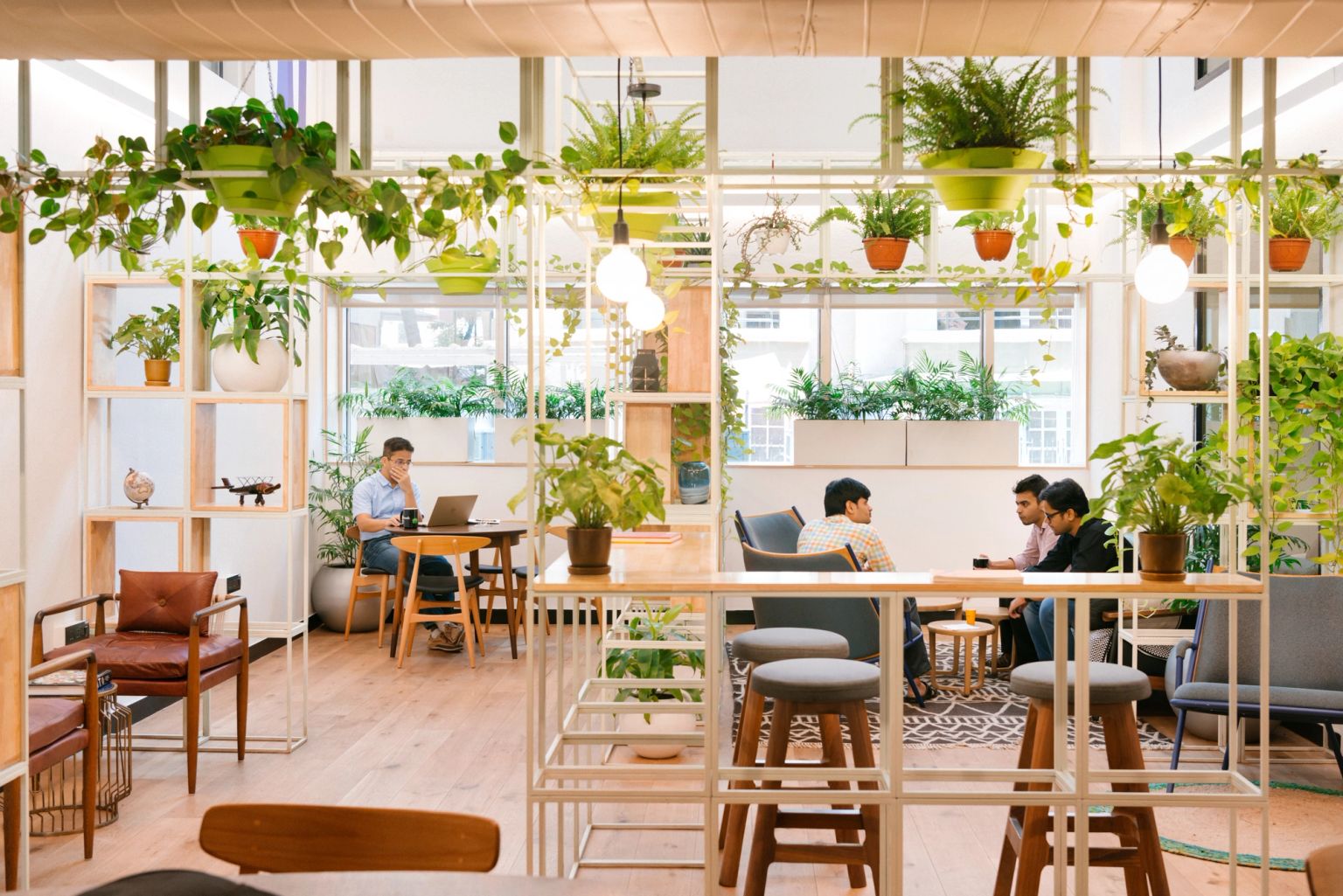
Biophilic design brings natural elements into your workspace to support occupant health, focus, creativity, and emotional wellbeing. Beyond plants and living walls, this extends to maximising natural daylight, incorporating organic textures and patterns, and designing sightlines to outdoor greenery, all of which reduce stress and improve concentration, contributing to lower absenteeism over time.
3. Sustainable materials and furniture
The materials you choose during a fit-out determine both the indoor air quality your teams experience and the embodied carbon of your workspace, which is why FSC-certified wood, bamboo, recycled metals, and reclaimed finishes are worth prioritising. For paints, adhesives, and sealants, look for low-VOC formulations to protect indoor air quality, and choose modular, durable furniture that can be reconfigured or refurbished, extending the useful life of your investment and reducing replacement waste.
For a practical overview of how workspace setup affects team performance, WeWork India's guide on ways to set up an office space to boost productivity is worth reading alongside this section.
4. Water conservation systems
India faces growing water stress, making water efficiency a critical component of sustainable office design. Low-flow faucets, dual-flush fixtures, sensor-operated taps, and rainwater-harvesting systems can measurably reduce water consumption in commercial interiors, while greywater recycling further reduces your dependence on municipal supply, particularly in water-scarce regions. Implementing these systems during the initial fit-out is far more cost-effective than retrofitting later.
5. Smart technology integration
IoT-based sensors and building management systems provide real-time visibility into energy consumption, air quality, occupancy patterns, and water usage throughout your workspace. Occupancy sensors can trigger lighting and climate control adjustments automatically when spaces are unoccupied, while air quality monitors can regulate fresh air intake based on CO2 levels. Over time, data from these systems lets you continuously refine your operations, turning sustainability from a one-time project into an ongoing improvement process.
Green certifications for offices in India
Pursuing a green certification validates your sustainability efforts through an independent, third-party assessment. India offers multiple certification pathways, each with distinct methodologies, rating scales, and areas of focus, so the right one for you depends on your project scope, budget, and sustainability priorities. The table below compares the most widely recognised certifications for commercial office projects in India.
| Certification | Administering Body | Rating Levels | Primary Focus Areas | Best Suited For |
|---|---|---|---|---|
| IGBC Green Interior | Confederation of Indian Industry (CII) through IGBC | Certified, Silver, Gold, Platinum | Site selection, water conservation, energy efficiency, materials, indoor environmental quality | Interior fit-outs and tenant-driven projects |
| LEED India | USGBC through GBCI | Certified, Silver, Gold, Platinum | Energy performance, water efficiency, materials and resources, indoor environment, innovation | New construction, core and shell, and commercial interiors |
| GRIHA | The Energy and Resources Institute (TERI) | One to five stars | Site planning, construction management, energy optimisation, occupant comfort, renewable energy | Government projects, institutional campuses, and large-scale developments |
How to plan a sustainable office fit-out
A sustainable fit-out starts well before the first contractor arrives on site, the planning phase determines whether your sustainability goals translate into measurable outcomes or remain aspirational targets on a project brief.
Begin with a site assessment. Evaluate your current or prospective space for existing energy performance, water infrastructure, natural light availability, ventilation capacity, and structural constraints, since this baseline data informs every subsequent design decision. If you are leasing, request records of energy consumption and water usage from the property owner to establish accurate benchmarks.
From there, set clear, measurable sustainability goals. Decide whether you are targeting a specific certification, such as IGBC Green Interior or LEED India, or pursuing internal sustainability KPIs, and define energy-reduction targets, material-sourcing standards, waste-diversion rates, and indoor-air-quality benchmarks accordingly. Documenting these targets early keeps your design team, contractors, and procurement partners aligned throughout the project.
With goals in place, prioritise materials and vendors based on lifecycle impact rather than upfront cost alone: weigh durability, recyclability, embodied carbon, and maintenance requirements, source locally wherever possible to reduce transportation emissions, and request environmental product declarations (EPDs) from vendors to verify sustainability claims with independently audited data.
Finally, integrate technology into the design phase rather than treating it as an afterthought. Planning sensor placements, wiring for building management systems, and infrastructure for future renewable energy integration during the initial design avoids expensive retrofits later.
Trends and pitfalls to watch for in 2026
Four developments are worth tracking as you plan your workspace. Carbon-neutral construction is moving from aspiration to execution, with developers and occupiers setting science-based targets that account for both operational emissions and embodied carbon in materials and construction processes, making lifecycle carbon assessments a standard fit-out requirement rather than an optional add-on. AI-driven energy optimisation is adding predictive capability to existing IoT monitoring systems, with algorithms analysing historical usage patterns, weather forecasts, and occupancy trends to pre-adjust HVAC, lighting, and ventilation before demand shifts occur, reducing energy waste at a level manual adjustments cannot match. Adaptive reuse and modular design are reshaping how companies approach workspace longevity, as demountable partitions, reconfigurable furniture systems, and plug-and-play technology infrastructure let workspaces evolve alongside your business without generating demolition waste at the end of each lease cycle. And zero-waste fit-out programmes are applying circular economy principles to office interiors: selecting materials that can be disassembled and reused at the end of life, diverting construction waste from landfills, and establishing operational recycling streams that prioritise composting over disposal.
Two pitfalls consistently undermine well-intentioned sustainability efforts. The first is treating surface-level changes as a comprehensive design: installing a living wall or switching to LED bulbs while ignoring HVAC inefficiency or high-VOC materials does not constitute sustainable design, and your approach needs to address systems holistically rather than just the visible elements. The second is splitting the design and construction process among disconnected vendors. When your architect, interior designer, contractor, and procurement team operate in silos, specifications get lost in translation, substitutions go unchecked, and certification documentation falls through the gaps, making this one of the most common sources of both cost overruns and sustainability compromises in office fit-outs.
From blueprint to execution
Sustainable office design is no longer a niche initiative reserved for large corporations with dedicated sustainability teams. It is a strategic decision that affects your operating costs, employee productivity, regulatory compliance, and brand perception, whether you are planning a new workspace from scratch or upgrading an existing one. The choices you make during the design phase will shape your environmental footprint and financial performance for years to come.
WeWork India operates 70+ centres across eight cities, offering flexible workspace solutions designed with sustainability in mind. Through Rivet by WeWork India, its design-and-build vertical, WeWork India helps businesses plan and execute office fit-outs that embed energy efficiency, responsible material sourcing, water conservation, and smart technology from day one, with all-inclusive pricing and no lock-in terms that make professionally designed, high-performance workspaces accessible to organisations of all sizes.
As India's commercial real estate sector continues to grow, the organisations that prioritise sustainable design today will be best positioned for long-term resilience. Explore workspace options to see how WeWork India can support your sustainability goals.
Ready to explore sustainable workspace options? WeWork India operates 70+ centres across eight cities with all-inclusive pricing and no lock-in. [Explore workspace options]
Frequently asked questions
What is sustainable office design, and why is it important?
Sustainable office design is an approach to planning and maintaining workspaces that minimises environmental impact while maximising occupant wellbeing and operational efficiency. Green-certified offices reduce energy costs by 20-30%, improve employee productivity, and strengthen regulatory compliance with India's tightening energy standards.
How much does a sustainable office fit-out cost in India?
A sustainable fit-out typically adds 8-15% to upfront costs over conventional options. Energy and water savings generally recover this premium within four to five years, depending on project scope, location, and certification targets.
What are the main green certifications for offices in India?
The most widely recognised certifications are IGBC Green Interior for tenant-driven fit-outs, LEED India for international recognition and global reporting, and GRIHA, India's national rating system developed by TERI. Each provides measurable benchmarks covering energy, water, materials, and indoor air quality.
How does biophilic design affect employee performance?
According to the Human Spaces report by Interface, employees in environments with natural elements reported 15% higher wellbeing and 6% greater productivity than those in conventional offices. Living walls, natural daylight access, and organic textures reduce stress and improve concentration over time.
Related Blogs:
SUSTAINABILITY IMPACT
Hiring the right candidate is one of the most important aspects of building a successful company.
SUSTAINABILITY IMPACT
At WeWork India, sustainability isn't just about our CSR and sustainability initiatives; it's woven into the fabric of our brand.
SUSTAINABILITY IMPACT
As the world becomes more conscious of environmental issues, the demand for sustainable office spaces has significantly increased.